
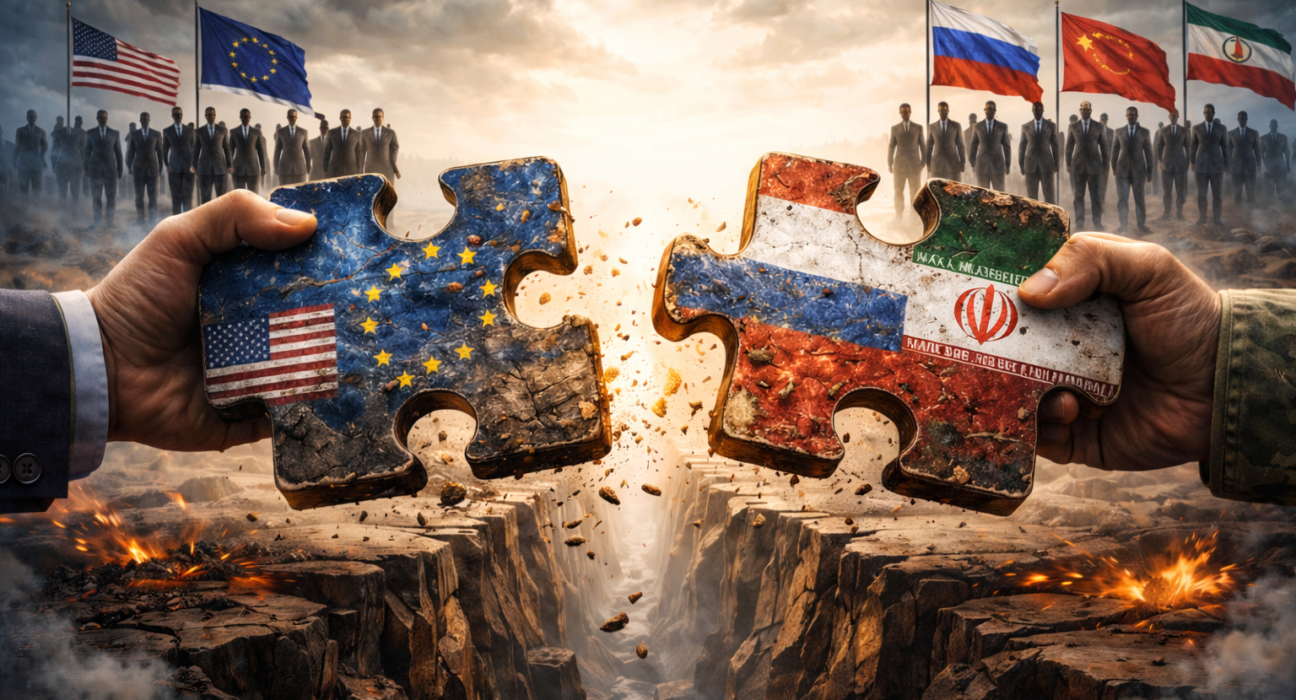
by Scott Douglas Jacobsen and Irina Tsukerman
Irina Tsukerman is a human rights and national security attorney based in New York and Connecticut. She earned her Bachelor of Arts in National and Intercultural Studies and Middle East Studies from Fordham University in 2006, followed by a Juris Doctor from Fordham University School of Law in 2009. She operates a boutique national security law practice. She serves as President of Scarab Rising, Inc., a media and security strategic advisory firm. Additionally, she is the Editor-in-Chief of The Washington Outsider, which focuses on foreign policy, geopolitics, security, and human rights. She is actively involved in several professional organizations, including the American Bar Association’s Energy, Environment, and Science and Technology Sections, where she serves as Program Vice Chair in the Oil and Gas Committee. She is also a member of the New York City Bar Association. She serves on the Middle East and North Africa Affairs Committee and affiliates with the Foreign and Comparative Law Committee.
Scott Douglas Jacobsen is a contributor to The Washington Outsider. Also, he is the publisher of In-Sight Publishing(ISBN: 978-1-0692343) and the Editor-in-Chief of In-Sight: Interviews (ISSN: 2369-6885). He writes for The Good Men Project, International Policy Digest (ISSN: 2332–9416), The Humanist (Print: ISSN 0018-7399; Online: ISSN 2163-3576), Basic Income Earth Network (UK Registered Charity 1177066), A Further Inquiry, and other media. He is a member in good standing of numerous media organizations.
Scott Douglas Jacobsen: We are facing, first, a world in flux and, second, faltering alliances. My editorial framing is: what is behind it, and therefore what is ahead of us. It sounds clever, but it is not; it makes a serviceable line.
The alliances we have traditionally relied upon in the intelligence world include the Five Eyes—the United Kingdom, Australia, New Zealand, Canada, and the United States—and NATO (the North Atlantic Treaty Organization). Then there is BRICS: Brazil, Russia, India, China, and South Africa.
These societies—however they are constructed—and the alliances between them are more fragile than people who grew up assuming their permanence tend to believe. What is driving these faltering alliances? On the one hand, weakening alliances among democratic or semi-democratic states differ from alliances among more autocratic or theocratic states. Weeks ago, when I asked you about this at the intelligence level, you noted that China and Russia maintain a partnership while also running extensive intelligence and espionage operations against one another.
They cannot fully trust each other. Some alliances are best understood as low-trust bilateral relationships. What are your thoughts on the broader picture? There is a great deal happening at once. I want to push back on one point. In my view, BRICS is not comparable to NATO; that comparison is closer to apples and oranges. BRICS is primarily an economic and political coordination forum rather than a collective-defence alliance. If we are looking for a closer analogue to a security-oriented bloc, the Shanghai Cooperation Organization is a better comparison point—though it is not a NATO-style mutual-defence pact either.
Irina Tsukerman: The world paid closer attention to this ecosystem as India’s participation deepened. Recent reporting described a U.S.–India trade dispute that escalated into sharply higher tariffs, including a move to 50 percent tariffs on certain Indian goods in 2025, in part linked to India’s continued oil imports from Russia.
India has been a member of the Shanghai Cooperation Organization for years, but its level of engagement has varied. More recently, the pattern has suggested increased strategic and military coordination with Russia and China in certain areas, alongside ongoing competition and distrust. The most recent reports indicate that India may also further open parts of its market to Chinese firms that were previously restricted, signalling a shift in economic calculations.
This does not mean BRICS is useless. There is substantial distrust among members, and their economic structures and interests diverge sharply, making cohesion difficult and dependent on specific objectives. Talk of a single BRICS currency has circulated for years, but no such currency exists, and the obstacles remain immense. On de-dollarization, there has been some growth in local-currency trade and alternative payment channels, but the U.S. dollar remains dominant in global reserves and international finance. Where there has been more tangible progress is in selective workarounds—alternative financial plumbing, sanctions mitigation, technology exchange, and the construction of parallel venues that reduce reliance on Western systems.
Favourable trade exchanges and related mechanisms have been relatively successful and continue to grow in importance. In practical terms, trade among BRICS countries has increased substantially. BRICS has also expanded to include additional members beyond the original group, such as the United Arab Emirates and Egypt. As a result, trade volumes within the expanded BRICS framework now exceed trade with the G7 in some measures.
This development is not necessarily disastrous for the global order as it currently exists, but it does advance economic polarization. It also reflects the efforts of authoritarian and less democratic regimes to draw significant power players into their sphere of influence and to counter Western attempts to promote a more transparent and consistent economic and political order. Are the internal tensions and distrust among these countries likely to be resolved in the near or even mid-term future? Probably not. But in terms of consolidating power, expanding influence, and, in some cases, causing harm to others, they are clearly succeeding.
The more their objectives rely on broad, higher-order cooperation rather than narrowly defined, trust-dependent exchanges, the more successful they are likely to be.
Turning to NATO, the alliance was initially quite strong. I disagree with the claim that it was always weak or essentially nonexistent. Recently, however, I spoke with a Canadian diplomatic colleague who believes the alliance is effectively already dead, with Trump merely driving the final nail into the coffin rather than dismantling a previously robust partnership. There is some truth to that view. Even before Trump took office, there were significant disagreements between the United States and its NATO partners over defence contributions.
Trump was not the first U.S. president to raise this issue. Biden, Obama, George W. Bush, and others all made similar arguments, with little lasting resolution. In my view, however, this was not the most serious dispute and could have been resolved by other means. The deeper problem is that NATO has drifted from its original mission. This is not only because the Cold War was assumed to be over, leading to insufficient attention to Russia and, later, China, but also because some member states pursued alternative agendas.
Hungary is a clear example. It has advanced goals that align more closely with authoritarian-leaning systems, both domestically and in its relationship with Russia, rather than fully integrating with traditional Western liberal democracies. Over time, what I see is a troubling divergence: countries such as Ukraine, despite serious internal political challenges, are actively seeking deeper integration with the West, while some former partners are moving toward a proto-authoritarian, corrupt, and anti-liberal order. This shift is polarizing the alliance far more than the election of any single leader.
The election of Trump is a symptom rather than the cause of this disarray. He could only be elected because a large portion of the population had already become deeply skeptical of existing international commitments.
That said, I do not believe the alliance is entirely dead, nor do I think these processes are irreversible. What we are witnessing is a battle of ideas and commitments. The current generation of leaders in Europe and elsewhere has been deeply uninspiring and has failed to articulate what is required not merely for the survival but for the flourishing of Western liberal societies.
This failure is driven in part by short-term political survival instincts, fear of social discomfort, and a reluctance to confront constituencies with unpopular and unsettling realities. However, poor leadership is not inevitable, nor does it have to endure indefinitely.
This is an essential opportunity for intelligent, committed, and honest leaders to step forward and provide a unifying vision for foreign policy and political ethics. Most people are not inherently inclined toward either authoritarianism or liberalism. They want good governance and effective leadership, and they will follow those who demonstrate that they can deliver results.
You can be a bad leader and still succeed. Leaders with destructive or unethical ideas can bring those ideas to power if they are confident, persistent, skilled at manipulating public opinion and institutions, and consistent in pursuing their direction. Trump is an example of this dynamic. But the exact mechanisms of success can apply to leaders who unify, seek to preserve liberal values, and defend the qualities that make open societies worth sustaining—qualities that explain why so many people around the world want to live in them.
This is the moment for such leaders to translate those values into action. Strength and leadership are not synonymous with moral failure. You can be a strong leader and a bad leader, but you can also be a strong leader and a good one. At present, the bad leaders appear to be prevailing, but that outcome is neither inevitable nor necessary. The same leadership strength, applied to different ideas, can be equally effective, as history shows.
In times of crisis, we have seen leaders emerge who led by example—figures such as Churchill, Margaret Thatcher, Reagan, and Eisenhower, as well as others in different countries. Rather than demoralizing their populations with self-serving or empty rhetoric, they inspired people through personal commitment and sacrifice. There is no shortage of intelligent individuals in our societies today, even though they face an uphill battle. Societies have deteriorated significantly, in part due to poor leadership and misguided policies.
Still, the underlying instincts for renewal are there. They can be awakened, just as they have been at other moments in history. Humanity did not remain trapped in the Dark Ages forever, nor did it stay locked in World War II indefinitely. The international community overcame those crises despite profound divisions and challenges, and it did so without the benefits of the technologies, historical records, and accumulated knowledge that we now possess. For that reason, I remain optimistic that renewal is possible. Whether leaders will actually act on that opportunity is another matter.
As for posturing, there is a great deal of it on all sides, regardless of whether we are talking about NATO-aligned actors or their counterparts in organizations like the Shanghai Cooperation Organization. Posturing is easier than making difficult decisions and explaining them honestly to the public. Authoritarian leaders have an advantage in this respect: they do not have to explain themselves, and they can lie with impunity.
In democratic systems, outright lying is harder to sustain because leaders are accountable to their constituencies and can ultimately be voted out of office. This has produced a class of leaders who occupy an uncomfortable middle ground. They do not want to fabricate stories outright, they do not want to resemble the authoritarian leaders they oppose, and yet they hesitate to confront the truth fully. The reality is that we face an arduous struggle ahead—one that will require real sacrifice and a fundamental rethinking of our mental frameworks and social structures. We cannot continue as we have, and no one wants to be the leader who has to say that openly.
This unwillingness to accept even minimal discomfort, the atrophying of basic survival instincts, and the refusal to fight to preserve freedom, lifestyles, values, and interests are precisely what fuel rhetoric from figures like Putin, who claims that Western societies are in decay.
Not because Russia is better—it is not. Not because it values human life—it clearly does not. The argument they are making is different: we are willing to go to any lengths to get what we want, even if it is destructive. They openly acknowledge corruption and cruelty. They boast about it. Their message is essentially this: You claim to be the good guys. If you genuinely believe in your values, why are you not fighting for them? That critique, uncomfortable as it is, resonates.
Recent attacks are alarming. At least several people have been killed and many more injured. It is especially concerning if these weapons continue to be used without adequate air defences. At that point, I start to wonder what European and other leaders are thinking. Do they not understand that if this continues, it is only a matter of time before these missiles reach their own countries?
Jacobsen: I agree with Garry Kasparov’s point: Ukrainian soldiers on the front lines are the reason Europeans can still drink coffee and eat croissants in the morning. He has become more direct and more urgent than ever.
Tsukerman: After drones entered Poland and other neighbouring states, it became impossible to ignore reality. Russia, despite enormous losses and repeated failures, is not backing down. You can wish it away, claim it is on the verge of collapse, but it continues to act.
Jacobsen: If Russian society survives these losses, it risks becoming a vassal state of China on a fast track.
Tsukerman: If I were European leaders, I would begin offering bonuses and priority jobs to volunteers willing to serve on the front lines. These would need to be organized, trained, and disciplined units—not uncoordinated volunteers who create more problems than they solve. I would deploy volunteer brigades with the government’s explicit approval, provide financial compensation, and guarantee positions afterward. Service could be limited to fixed terms, such as six months, to allow recovery.
Ukraine faces a genuine shortage of people, but beyond that, Russia and its satellites need to see unmistakable commitment—not endless rhetoric, but concrete action backed by governments and societies willing to defend what they claim to value.
We also need to be having serious discussions about what comes next—about what happens afterward. We need to survive long enough to reach the day after, assuming there even is one at this rate.
That uncertainty is fundamental. I do not think Putin needs a symbolic exit that allows him to say, “I won.” Ideologically, territorial concessions do not offer him a way out. He cannot accept them, because partial concessions would trap him just as much as an outright loss. From his perspective, he needs complete victory, which means he has to keep going. That is what Trump and others either do not understand or do not want to understand. That press conference was painfully misguided.
Jacobsen: Thank you very much for the opportunity and your time tonight, Irina.