
By Ahmed Atef, Ph.D
At the beginning
The Federation of South Arabia was the name of a country located at the south of Yemen and was under British rule for 129 years (from 1839 to 1967). The South Arabian delegation who negotiated the agreement of independence in November 1967 opted to change the name of the country to “People’s Republic of South Yemen).
The majority of Southerners like to retain the old name of their country “The Federation of South Arabia” which others are still calling it “South of Yemen”.
The Union with North Yemen
With the help of Egyptian president Gamal Abdulnaser, North Yemen became independent from Imam Ahmed authority on September 26, 1963. The two countries of North and South of Yemen (South Arabia) continued to exist as two sovereign and independent states until May 22, 1990, when both leaders signed a union agreement to create a new entity “The Republic of Yemen” which became the internationally recognized government.
A Failed Union
The political union did not bring peace and stability to the “united Yemen”. During the first two years of the agreed transition period, the Northern regime began a wave of assassinations against the Southern military and political leaders. This unrest resulted in a war between the North and South armed forces in 1994. The Northern army led by the former president Ali Abdullah Saleh was supported by the Arab Afghans (Terrorists who fought against Soviets in Afghanistan) and Muslim Brothers’ Islah Party, invaded Aden and other Southern territories. Since 1994 the so-called “Unity” was nothing but an occupation.
The Power of the People
The Southerners continued their peaceful struggle against the Northern occupation. They formed Hirak (Popular Mobilization) movement against Saleh’s regime. Among the leaders of Hirak was Aidaros AlZubeidi, the current president of the Southern Transitional Council, who was the leader of Hatm (Self- Determination) Movement within Hirak. Mr. AlZubeidi was a strong opponent of former Northern president Saleh, and succeeded in challenging Saleh’s authority in the South; thus, receiving a “death penalty in absentia”.
The Hirak movement succeeded in organizing a one-million people march in Aden on May 4, 2017, to announce the formation of the Southern Transitional Council (STC) and mandated Mr. AlZubeidi to lead the new organization for the independence of the South.
The STC power
During the first two years of its declaration, the Southern Transitional Council (STC) succeeded in becoming a powerful organization that represents the will of the Southerners for self-determination and independence. In recognition of the influence of the STC, the countries in the region, mainly Saudi Arabia and UAE, and the UN Security Council agreed to include the STC in the shared government of the Republic of Yemen according to the Riyadh Agreement (November 2019). The STC leaders continue to work hand in hand with their Saudi and Emirati allies to confront Northerners Houthi militias who seized the power in Sana’a, the capital city of North Yemen, in September 2014.
The Presidential Leadership Council
In April 2022 the former president Abdrabbuh Mansour Hadi issued “Declaration of Power Transfer” and handed his power to an 8-member Presidential Leadership Council (PLC) in Riyadh, Saudi Arabia (one president and 7 deputies). The STC president AlZubeidi was one of these deputies along with three other Southern deputies in this new council.
The mandate of the PLC was to create the necessary environment to counter the Houthi threat and resolve it through “war or peace”. Thus far the PLC failed in its mission and differences emerged among its members.
The “Promising Future”
On December 2, 2025, the Southern forces carried the “promising future” operation to control the command of the first military region in Seyun, Hadramout, after evidence showing the engagement of the officers in this region in smuggling weapons and drugs to the Houthi militias in Sana’a, North Yemen, and in providing safe havens to A-Qaeda and Da’esh terrorists. The Southern forces soon after entering Seyun found several illegal oil refineries in the area which was believed to be benefiting Houthis and other North Yemeni tribal leaders.
According to a statement issued by the STC on December 3, 2025, the “promising future” operation was in line with the objectives of Arab Coalition for Restoring the Legitimate Authority in the Republic of Yemen. The Kingdom of Saudi Arabia has been leading this coalition since 2015.
After three weeks since the successful “promising future” operation, the Saudi Foreign Ministry[i] issued a statement on December 25, 2025, saying the STC military moves were unilateral and demanded the withdrawal of the Southern forces. Another statement by the Saudi Foreign Ministry[ii] (December 30, 2025) accused their ally, the United Arab Emirates, of exerting pressure on the STC forces to encourage their military moves near Saudi borders and considered these moves as a threat to the Saudi’s national security. When the Southern forces affirmed their right to control the first military region, the Saudi air strikes forced them to retreat. Saudi-backed National Shield and Joint Emergency Brigades invaded Hadramout and Al-Mahara and are still there until this moment.
The Southern Constitutional Declaration
On January 2, 2026, after the Saudi air strikes against the Southern forces in Hadramout, the STC president Aidaros Alzubeidi declared two important statements: the “Political and Constitutional Declarations”. The political declaration called for a two-year transition to encourage dialogue to facilitate peaceful transition to Southern independence. The Constitutional Declaration was a written constitution for the new Southern state.
On January 7, 2026, the Saudi Foreign Ministry called for a Southern Dialogue Conference in Riyadh and extended an invitation to STC to attend. A senior STC delegation arrived in Riyadh for a dialogue conference. President AlZubeidi was not among the Southern delegation. A statement from the spokesperson of STC explained that Alzubeidi had to stay in Aden to attend important political and security tasks. Upon their arrival in Riyadh, the STC delegation were placed in a hotel and were prevented from using their phones. In a surprise development, the Saudi air force resumed their strikes targeting Southern STC camps in Al-Dhale region including Zubeid, the hometown of AlZubeidi, resulting in civilian casualties.
Whereabout of AlZubeidi?
Since January 7, 2026, Mr. Alzubeidi whereabout is unknown. However, two narratives emerged: The first was a statement issued by Gen. Turki AlMaliki, the spokesman of the Arab Coalition Joint Forces in Yemen which said that UAE has facilitated the “escape” of Mr. AlZubeidi to Abu Dhabi, UAE via Somaliland and Somalia seaports. The STC spokesman on the other hand said Mr. AlZubeidi is still in the South among his people.
The Southerners reaffirm Independence
On Friday, January 16, 2026, hundreds of thousands (over a million in some estimates) of demonstrators gathered in Aden, South Arabian (South of Yemen) in support to the Southern Transitional Council (STC) and its leader Aidaros AlZubeidi, to demand the independence of their country.
The people of South Arabia (Southern Yemen) have for years endured war, instability, terrorism, and external domination. They have suffered under attacks from the Houthi militias, as well as from extremist groups such as Al-Qaeda in the Arabian Peninsula (AQAP), both of which threaten not only Southern communities but also regional and international security. Despite multiple international initiatives, their right to self-determination remains unresolved, and their legitimate political representation has been constrained rather than empowered.
In this struggle, the Southern people have found legitimate leadership in President Aidaros Al-Zubeidi and the Southern Transitional Council, which represent the aspirations of millions of Southerners for dignity, security, and the right to determine their own political future. Their resistance is not merely local; it is part of the broader fight against extremism and chaos in the Middle East.
PLC Unlawful Decisions
On January 7, 2026, the President of the Presidential Leadership Council (PLC) Dr. Rashad AlAlimi (from Taiz, North Yemen) issued several resolutions that contradicted the PLC mission as stipulated in the “Declaration of Power Transfer” of April 2022. Among such decisions was the ousting of Mr. AlZubeidi and Mr. AlBahsani from their seats in the PLC, and the removal of the governor of Aden and two ministers (Transport & Social Affairs ministers). In addition, Dr. AlAlimi issued an order to arrest AlZubeidi accusing him of “Treason”. This last move has immediately brough to memory a similar decree issued by former president Saleh against AlZubeidi several years ago.
In addition to the recent escalation caused by the PLC’s president unlawful decisions against the STC leaders, the STC Secretary General, Mr. Abdurahman AlSubihi, the head of STC delegation who arrived in Riyadh on January 7, 2026, to attend the Southern Dialogue Conference, was seen in the Saudi media announcing the dissolution of the STC. Such move was unexpected and has further complicated the situation. According to STC bylaws the dissolution of any structure within the STC, leave alone the whole STC, has to be approved by the president of the STC himself.
Despite such unlawful decisions by the PLC president, the pro-independence sentiment remains strong among Southern population. Large crowds rallied in Aden to oppose such unlawful decisions and demand independence and express solidarity with the STC’s leadership, signaling that political identities and people’s will for self-determination can never be defeated.
Southern Flag & Anthem in Riyadh
After the successful over a million demonstration of January 16, 2026, in Aden, the Saudi media broadcasted the proceedings of the “Consultative Southern Meeting-On the Way to Dialogue”. Many were surprised to see the Southern Flag and the Southern National Anthem be allowed to display in this meeting which started Sunday January 18, 2026, and will continue for several days.
AlMahrami Strong Speech
The vice president of STC, commander of Southern Giant Brigades Mr. Abdurahman AlMahrami was the chairman of the Consultative Southern Meeting in Riyadh. He delivered an important speech affirming the just Southern cause and expressed his appreciation to the “Kingdom of Saudi Arabia for supporting the right of the Southern people for political self-determination including the right to regain the full sovereign Southern state”. Many observers saw AlZubeidi in the speech of AlMahrami.
The main purpose of Riyadh Southern Dialogue meetings is to develop a unified Southern vision while addressing long-standing regional grievances and instability. It is too early to see a unified position among the delegates who are attending Riyadh meetings because there are preparations to conduct meetings with Southern none-STC delegates as well as with North Yemeni delegates in the coming days.
The UN role & Humanitarian Impacts
The UN Security Council held its regular monthly meeting on “Yemen Republic” on January 14, 2026. The UN Envoy, Mr. Hans Grundberg, briefed the meeting on the current situation in the country. He pointed to the fact that “The future of the south cannot be determined by any single actor or through force”. While the UN envoy continue his efforts to create a meaningful political process that can bring all stakeholders to a just political settlement of the crisis in the “Republic of Yemen”, the turmoil in the South and the continuation of Houthi atrocities in the North exacerbate a humanitarian crisis that continues to afflict the entire populations in both South and North Yemen. Years of conflict have left millions at risk of acute food insecurity, with aid access frequently disrupted. The PLC and the government of “Republic of Yemen” are dysfunctional and cannot address the deteriorated humanitarian situation while staying abroad.
The continued unaddressed Southern grievances and geopolitical regional rivalries continue to shape the trajectory of events in the South and the North Yemen alike. In addition, the continued absence of authorities will create a security vacuum that would invite Houthi militias supported by the AQAP and Da’esh terrorists to fill in.
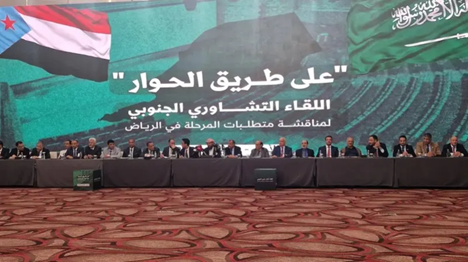
Riyadh, Saudi Arabia, Sunday January 18, 2026