
by Scott Douglas Jacobsen and Irina Tsukerman
How can societies remain deeply dependent on global systems while becoming more ideologically isolated, transactional, and vulnerable to extremism?
Irina Tsukerman is a human rights and national security attorney based in New York and Connecticut. She earned her Bachelor of Arts in National and Intercultural Studies and Middle East Studies from Fordham University in 2006, followed by a Juris Doctor from Fordham University School of Law in 2009. She operates a boutique national security law practice. She serves as President of Scarab Rising, Inc., a media and security strategic advisory firm. Additionally, she is the Editor-in-Chief of The Washington Outsider, which focuses on foreign policy, geopolitics, security, and human rights. She is actively involved in several professional organizations, including the American Bar Association’s Energy, Environment, and Science and Technology Sections, where she serves as Program Vice Chair in the Oil and Gas Committee. She is also a member of the New York City Bar Association. She serves on the Middle East and North Africa Affairs Committee and affiliates with the Foreign and Comparative Law Committee.
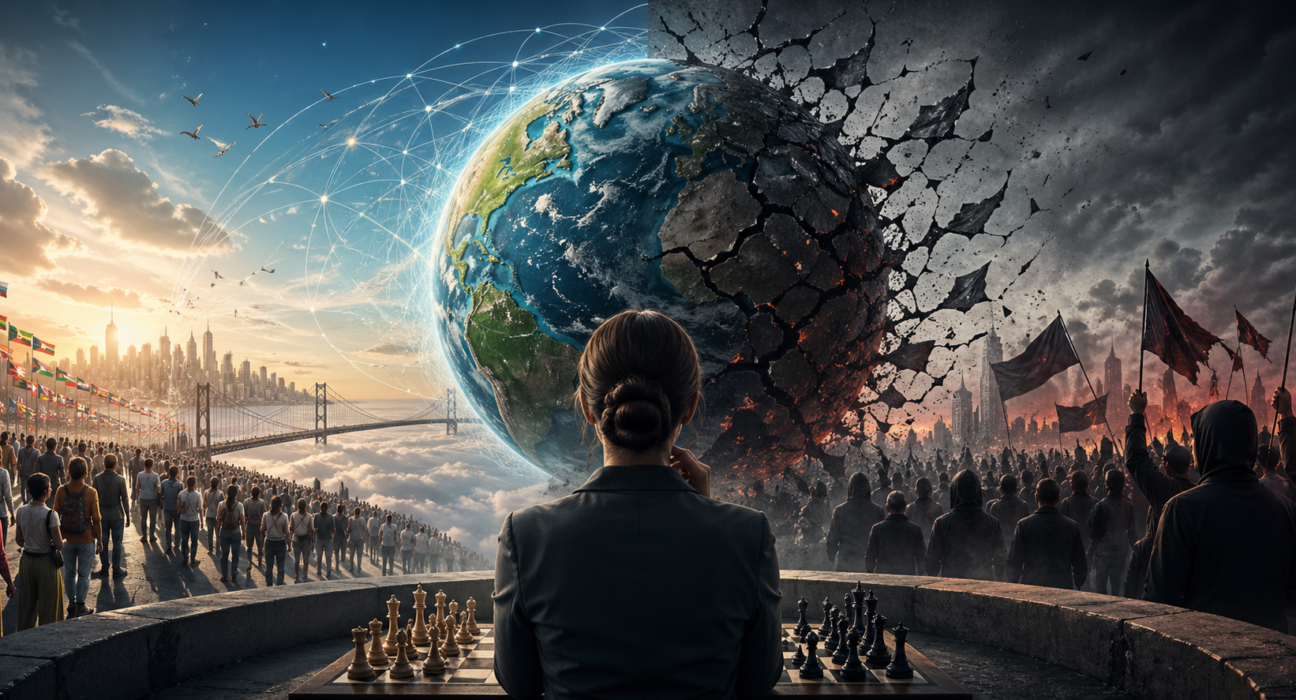
Scott Douglas Jacobsen and Irina Tsukerman examine the paradox of a hyperconnected world that is simultaneously fragmenting into ideological, tribal, and transactional camps. They argue that genuine isolationism is largely impossible in an interdependent system shaped by trade, technology, energy, conflict, and digital communication. Yet globalization has intensified dehumanized exchange, online radicalization, nihilistic extremism, and distrust in expertise. The conversation explores how trauma, propaganda, and algorithmic mediation reshape political identity and social reality. Both emphasize that ethical education, critical thinking, and better frameworks for evaluating authority are essential if societies are to resist manipulation, extremism, and humanitarian decline.
Scott Douglas Jacobsen: The big thing I am getting into has definitely been this. Our collaboration comes during one of the busiest geopolitical periods of at least the last six months. The big trend I am seeing from these geopolitical conflagrations, tensions, rights violations, and humanitarian catastrophes is that there are very few truly isolated pockets left in the world.
In the geopolitical context, isolation now often means relative insulation rather than real separation. Most systems are too integrated at this point, with some exceptions among uncontacted or voluntarily isolated Indigenous groups, especially in parts of the Amazon. Even those communities are increasingly threatened by outside encroachment, disease, land theft, and missionary or extractive intrusion.
A more accurate way to frame a statecraft fault-line system is that there are no real islands anymore in global politics. That pattern has probably been in place for some time, but these recent eruptions have brought it into sharper focus for me. What are your thoughts?
Irina Tsukerman: Honestly, this whole idea of isolationism was almost a shtick, in the sense that I am not sure the people who pushed those policies fully believed they were ever possible. To the extent that we are seeing attempts by various countries to reduce dependence on the American technological sphere—for instance, European efforts around digital sovereignty, AI regulation, data governance, and more autonomous technology infrastructure—this is not necessarily a positive development in every respect, even if some of it is understandable from a strategic point of view.
It can make communication more difficult and the exchange of ideas less fluid. Admittedly, the current exchange of ideas is not ideal. It promotes echo chambers and does not necessarily lead to a fair exchange of ideas or an unstructured flow. Still, it is better than a situation in which conversations are divided more sharply along political and geographical lines, rather than one in which people at least have the opportunity to meet in cyberspace and interact with people from around the world.
Real isolationism is not a positive thing. It makes communication, trade, and cooperation much more difficult, and it limits the internal availability of goods, products, services, and ideas. I do not think full isolationism is truly possible, but we are facing a strange situation in which, on the one hand, we are becoming more connected than ever before, while, on the other hand, we are sorting ourselves into camps.
These divisions run along ideological lines and, increasingly, along lines that are not even strictly ideological anymore, but separate people willing to engage in open thought, debate, and discourse from those slipping into tribal mentalities, whether political sectarianism or more ethnocentric and communal forms of self-isolation. We are globalizing and isolating simultaneously in different ways.
It is a strange situation in which we are clearly affected by international and global events—by energy prices, the availability of critical minerals, and political decisions regarding conflict, water, trade, and tariffs. At the same time, many people seem to want maximum distance from those who are different from them, while guarding imagined personal spaces and constructed identities more closely than ever, at least in recent decades.
I do not know how these two paradigms can coexist simultaneously. How can we be so dependent? How can we depend on international resources while being so isolated from other people on humanitarian, social, and interaction, discourse, and engagement levels? It is a very consumerist way of engaging with the rest of the world and, in many ways, a very dehumanizing one.
Jacobsen: It is probably connected to digital technology. It overlays language. Despite visual representations and other media, language still acts as shorthand for experience and for conceptual operations that create space for ideas. Global digitization has facilitated communication in that way. At the same time, people, experiences, nations, and trade increasingly become icons.
That may follow from how we have created more efficient transactional relationships with the world. Transactionalism has become more efficient because we no longer conduct trade primarily through direct barter or through large numbers of intermediaries, even though we still maintain ambassadors and diplomatic representatives.
Part of the transactional relationship we are seeing is a consequence of the utilitarian aspects of trade, commerce, and communication.
Tsukerman: Yes, we are globalizing transactional relationships, but we are not globalizing humanitarian or human engagement. That is a very dangerous combination. When transactions are devoid of ethical boundaries and human connection, and lack basic acknowledgment of other people’s humanity, they can easily lead to an unhealthy form of utilitarianism in which we use one another without ethical constraints. That can lead to outcomes ranging from increased corruption and crime to wars and mass atrocities, where human beings themselves become another form of product.
Jacobsen: That is a very good point. Thinkers like Jeremy Bentham and, particularly, John Stuart Mill were keen on utilitarianism, in the sense of evaluating the positive and negative consequences when assessing the morality of actions. That raises the question of what implicit or intrinsic utility functions we are actually using when communication and trade become purely transactional.
One consequence of this has been a series of derivatives. For example, we are seeing the globalization of propaganda and the globalization of extremism. Political messaging becomes intertwined with extremist mobilization. In some contexts, people speak of the “globalization of the intifada,” but another way to frame it is the globalization of terrorism, because messaging circulates globally and helps build transnational extremist networks.
We are also seeing the rise of lone-actor terrorism. Based on the North American experience, the United States has seen lone-actor attacks linked to white nationalist and Christian extremist ideologies, as well as Islamist extremism. In Canada, according to one CSIS expert I interviewed, violent extremism cases often involve misogynistic or incel-related ideologies, again frequently involving lone actors.
It becomes easier to isolate yourself and become radicalized when you engage with others primarily through abstract interaction on a computer screen, where ideological messaging can reach you without much social friction.
Tsukerman: In some ways, that assessment is correct. Extremist networks have never been as globalized as they are now. We are seeing groups that would never have found ideological common ground begin to connect. They do not merely communicate; they also adapt and reshape one another’s ideas. Their ideologies become modelled, replicated, and extrapolated across movements. And we are not talking about just one group or one ideology.
There is a theory that the radical right and the radical left will join forces against a common enemy. What we are seeing, however, goes beyond that. We are seeing people who do not have much in common in terms of ideology, methods, or targets, overlooking those differences and forming what becomes a kind of collective mass of extremism.
We are talking about nihilism spreading across boundaries. The fastest-growing category of extremists is not necessarily left-wing, right-wing, Islamist, or any single ideological group. Instead, it increasingly includes nihilistic violent actors who cynically enjoy oppressing others and exercising power for its own sake, often motivated by nothing more than the devaluation of life and a desire to demonstrate contempt for social norms.
Jacobsen: Two examples come to mind. First, I have been speaking with several Ukrainian friends recently. Their sense of social reality is different now than it was in 2023 or 2024. When I used the English term “fatalism,” there was pushback; from their perspective, that description did not quite fit. However, the idea of nihilism or indifference toward certain outcomes did not produce the same reaction. That concept seemed more accurate in describing aspects of the psychological environment created by prolonged conflict.
Long-term trauma across an entire population can lead to attitudes that resemble the extreme cases we sometimes observe at the individual level, although individual cases can develop much more quickly. These situations often involve strong negative emotions that become translated into action, sometimes accompanied by a desire to punish others for grievances that are, in many cases, largely imagined or exaggerated in lone-actor situations.
A second example comes to mind. Tolo News was one of the largest news networks in Afghanistan before the Taliban returned to power, particularly during the roughly twenty years of U.S. and NATO presence in the country. I asked someone about the broader context of radicalization.
When thinking about individuals who became radicalized, it occurred to me that many had lived through multiple eras of conflict: the Soviet war, the civil wars that followed, and, later, the American presence. Their entire lives were shaped by war and instability. I asked whether some interpretations of religion in those contexts resembled the outlook of highly traumatized individuals whose lives had been defined by chaos and the externalization of control. In other words, their sense of agency might shift from internal to external.
When societies develop under those conditions, the structures they produce can reflect that dynamic. In Afghanistan today, for example, international indices consistently rank the country at or near the bottom globally in terms of women’s rights and gender equality. The theocratic leadership imposes extensive control over the population, particularly over women and girls.
When I look at these wartime contexts and the severe restrictions now imposed on Afghan women and girls, I notice certain recurring patterns. I say this with an important caveat: I am not a professional psychologist or trauma therapist. However, people with direct experience in these contexts—both media professionals and ordinary individuals—have suggested similar interpretations in conversation.
At the same time, exposure to extreme conditions does not automatically lead people to become politically motivated terrorists. Something different is happening in the psychology of lone-actor extremists. The outward manifestations may resemble broader social trauma, but the individual motivations and pathways into violence appear to be distinct. I do not have a definitive explanation; it is more of a working hypothesis based on conversations and observations.
Tsukerman: Interestingly, there are now numerous studies examining nihilistic movements, especially among disaffected youth who join online extremist communities and participate in extremist discourse. These individuals often engage in provocative, racist, misogynistic, or otherwise hateful discussions without any coherent ideological framework beyond self-aggrandizement.
Yet there is still relatively little consensus on how to counter these dynamics effectively. There has been a great deal of discussion about banning young people from joining social media until they are 16. That is not an effective answer. These discussions are taking place in several places—the United Kingdom, France, Australia, and others. In the United States, implementing such measures legally is more difficult, but the conversations are still happening, even if the laws are not currently moving forward.
The underlying idea is that we should shield young people from anything unpleasant. However, if someone is shielded from the existence of threats until the age of sixteen and then suddenly exposed to them the moment it becomes legally permissible, what do we expect will happen? Who is more likely to be seduced by a dangerous or manipulative idea—someone who has been gradually and thoughtfully introduced to the fact that such threats exist, or someone who has never even heard of them and suddenly encounters them without preparation? The answer seems fairly obvious.
Beyond what is described as exposure education, there appears to be little enthusiasm for returning to the teaching of basic ethics, critical thinking, and a more humanizing view of the world from an early age. Exposure to technology, commerce, and new ideas should be accompanied by exposure to ethical norms, social responsibility, and the habits that help people become constructive members of society.
Jacobsen: Another important aspect of critical thinking is acknowledging the importance of expertise. For example, if I were asked to analyze a high-level international human rights document or report and I encountered something I did not fully understand, and someone with a similar level of qualification also struggled with it, it would likely indicate that we do not have the necessary background. Acquiring the appropriate background in many fields requires years of advanced education and training.
This applies across many domains. Part of the humanitarian point you raised involves trust in relevant institutions and authorities in particular fields. There is too much knowledge in the world for any one person to master every subject. At some point, everyone relies on informed trust. The challenge is developing the judgment to know what should be trusted and what should not.
There are clear examples. In scientific matters, if someone hears claims from figures such as Ken Ham about creationism—such as the Ark Encounter in Kentucky—many scientifically literate people will approach those claims skeptically and instead rely on organizations such as the National Center for Science Education, which provides research-based explanations of evolutionary science and science education. That pattern repeats across fields.
Tsukerman: One practical solution is to teach future generations basic frameworks for reading and analyzing information of all kinds—scientific, political, or otherwise—so that they have tools to evaluate expertise. A well-known name alone does not guarantee integrity. We frequently hear stories about individuals plagiarizing, fabricating sources, or taking shortcuts in the scientific process. That does not invalidate science itself; it simply means that some individuals behave unethically and do not deserve professional trust.
To understand the difference, people need a basic framework that allows them to interpret these processes and read complex materials from an early age. Without preparation, people will either unquestioningly trust or outright reject everything.
Unless ethical and critical thinking frameworks are introduced early in life, people will be unprepared to question authority and distinguish truth from deception. In that situation, they may fall for anything that appeals to their emotions, or they may become inherently distrustful of everyone and everything. In either case, they become vulnerable to manipulation.
There must be a way for people to evaluate information independently, to identify credible authorities, and to question claims when necessary. At the same time, they must be able to assess intentions and recognize when someone is using reliable methods versus when someone is simply acting as a charlatan.
Jacobsen: See you next week.
Tsukerman: Yes, that sounds good. Stay safe.
Jacobsen: Bye.
Scott Douglas Jacobsen is a contributor to The Washington Outsider. He is the Founder and Publisher of In-Sight Publishing (ISBN: 978–1–0692343; 978–1–0673505) and Editor-in-Chief of In-Sight: Interviews (ISSN: 2369–6885). He writes for International Policy Digest (ISSN: 2332–9416), The Humanist (Print: ISSN, 0018–7399; Online: ISSN, 2163–3576), Basic Income Earth Network (UK Registered Charity 1177066), Humanist Perspectives (ISSN: 1719–6337), A Further Inquiry (SubStack), Vocal, Medium, The Good Men Project, The New Enlightenment Project, The Washington Outsider, rabble.ca, and other media. His bibliography index can be found via the Jacobsen Bank at In-Sight Publishing comprised of more than 10,000 articles, interviews, and republications, in more than 200 outlets. He has served in national and international leadership roles within humanist and media organizations, held several academic fellowships, and currently serves on several boards. He is a member in good standing in numerous media organizations, including the Canadian Association of Journalists, PEN Canada (CRA: 88916 2541 RR0001), Reporters Without Borders (SIREN: 343 684 221/SIRET: 343 684 221 00041/EIN: 20–0708028), and others.