
By Gilles Touboul
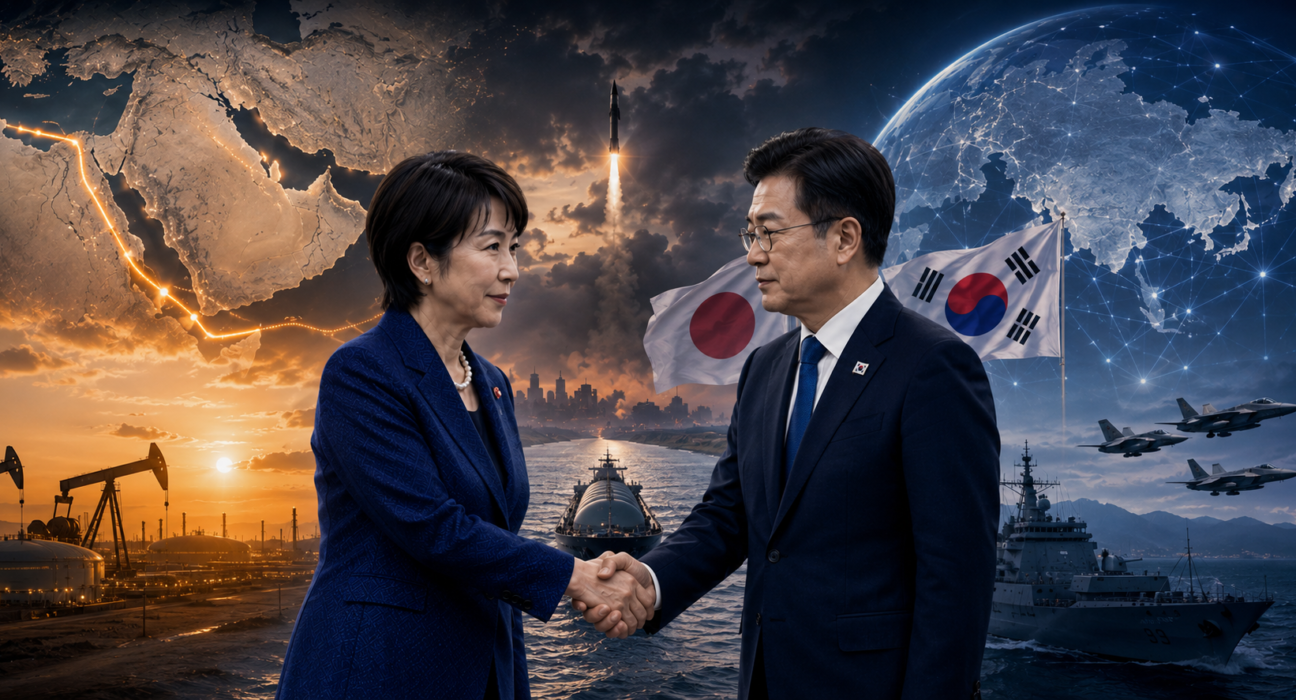
The rapprochement between Japan and South Korea is often explained by the same words: China, North Korea, Russia, Taiwan, missiles, technology, and American pressure. All of this is true. Tokyo and Seoul are not suddenly becoming close friends. They are becoming strategic partners because the world around them is becoming more dangerous.
But there is another, less visible question: could this rapprochement also reflect the recent shift in American policy in the Middle East, especially around Iran and Israel?
Yes, but indirectly.
Japan and South Korea are not moving closer because of Israel. They are not building a new security architecture solely because of Iran. But the Middle East has become a mirror, showing Asian allies what can happen when a regional crisis becomes global, when energy routes are threatened, and when the American guarantee appears less automatic than before.
The first connection is energy.
For Japan and South Korea, the Strait of Hormuz is not a distant Middle Eastern issue. It is an Asian economic lifeline. A major part of the oil and gas that feeds Asian industries passes through this narrow maritime corridor, and the International Energy Agency notes that around a quarter of the world’s seaborne oil trade passed through Hormuz in 2025, with limited alternatives if the Strait is disrupted. (IEA)
This matters deeply for Tokyo and Seoul. Their economies depend on stable maritime flows. Their industries need energy security. Their semiconductor, automobile, shipbuilding, chemical, and technology sectors cannot function in a world where Gulf energy becomes unpredictable. So when Iran threatens Hormuz, when Israel and Iran move toward confrontation, or when Washington changes its tone toward Tehran, Japan and South Korea do not see a regional crisis; they see a direct threat to their economic model.
This is why the Middle East accelerates Asian cooperation.
The second connection is American reliability.
For decades, Japan and South Korea lived under the protection of the United States. This remains true. The American military presence is still central in the Indo-Pacific. But the nature of this guarantee is changing, becoming more political, more transactional, and more dependent on Washington’s mood.
The Middle East has made this visible. If the United States can pressure Israel, negotiate with Iran, seek de-escalation quickly, or prioritize oil prices and global stability over the preferences of one ally, then Asian allies ask themselves a simple question: could this happen to us one day?
This does not mean that Japan and South Korea no longer trust America. It means they are learning not to depend only on America.
That is the real meaning of the rapprochement. Tokyo and Seoul are not replacing Washington. They are preparing for a world where Washington may be powerful but distracted, strong but inconsistent, present but less predictable.
Recent Japanese-South Korean defense contacts clearly show this direction. Reuters reported that both countries have reaffirmed closer defense ties, with American encouragement, while still carrying the weight of historical tensions. (Reuters) A few weeks earlier, they even discussed a possible military logistics support agreement, a sensitive step that reflects the past between the two countries. (Reuters)
The third connection is North Korea.
Pyongyang watches Iran very carefully. If Iran resists pressure and receives concessions, North Korea may conclude that nuclear and missile pressure works. If Iran is hit militarily, Pyongyang may conclude the opposite: that only stronger deterrence can protect the regime.
In both cases, Japan and South Korea receive the same message. The Iranian file is not isolated. It speaks to every state that uses missiles, nuclear ambiguity, proxies, or coercion as instruments of power. For Seoul and Tokyo, Iran is not only a Middle Eastern actor. It is also a precedent.
The fourth connection is China.
Beijing observes every American hesitation. If Washington is absorbed by Iran, Israel, Hormuz, oil prices, and Gulf security, then the Indo-Pacific becomes more exposed. China does not need to act immediately; it only needs to see whether the American system can manage several crises at once.
This is why Japan and South Korea are moving closer. They are sending a message not only to North Korea, but also to China: even if America is distracted, Asia will not be strategically disorganized.
This rapprochement is therefore not emotional. It is not reconciliation for reconciliation’s sake. It is a cold calculation. The past still weighs heavily between Japan and South Korea: colonial memory, territorial disputes, public opinion, and political mistrust. These issues have not disappeared. But the strategic environment is now stronger than historical resentment.
There are three possible readings.
The first is limited: Japan and South Korea are simply reacting to China and North Korea. In this view, the Middle East is secondary.
The second is broader: the crisis around Iran, Israel, and Hormuz has reminded both countries that their security is global. A war in the Gulf can damage Asian prosperity.
The third is deeper: Tokyo and Seoul are adapting to a new American era. Not an American collapse, but an American uncertainty.
This third reading is the most important.
The world is entering a moment in which allies do not abandon the United States but prepare for American hesitation. They still need Washington. But they also need each other.
Japan and South Korea are therefore not only reacting to Asia. They are reacting to the whole world. The Middle East is part of this calculation because it reveals the fragility of energy, the limits of American permanence, and the danger of strategic isolation.
In the end, the lesson is simple: Tokyo and Seoul are not becoming friends because history has changed. They are becoming partners because the future is more dangerous.