
by Scott Douglas Jacobsen
How does Sofia Nordgren explain the causes of illegal adoption and the need for emotional justice?
Sofia Nordgren is an international speaker, author, moderator, transformation coach, entrepreneur, and advocate for adoptee rights, identity, family reunification, and social justice, with more than 30 years of professional experience in health, wellbeing, leadership, coaching, and personal development.
With a professional background in nursing, coaching, leadership, and personal development, she has spent more than three decades supporting people through trauma, grief, stress-related conditions, mental health challenges, identity issues, major life transitions, and personal growth. Her experience spans primary healthcare, mental health services, occupational health, elder care, health promotion, education, leadership, and coaching. She is trained as an ICC-certified coach and NLP Practitioner and has continued her professional development in areas including ACT, trauma, resilience, communication, attachment, belonging, identity, and psychological wellbeing.
She has spoken internationally in Sweden, New York, and Belgrade, moderated events at Stockholm City Hall, appeared in television programs, podcasts, interviews, documentaries, and media productions, and participated in conferences, leadership forums, and international discussions concerning health, identity, human rights, resilience, and social change.
Over the years, she has built extensive international networks and collaborates with adoptees, researchers, advocates, journalists, filmmakers, organizations, and professionals from multiple countries. She regularly participates in international conferences, webinars, interviews, and cross-border initiatives addressing adoption, identity, family tracing, human rights, and the long-term consequences of family separation.
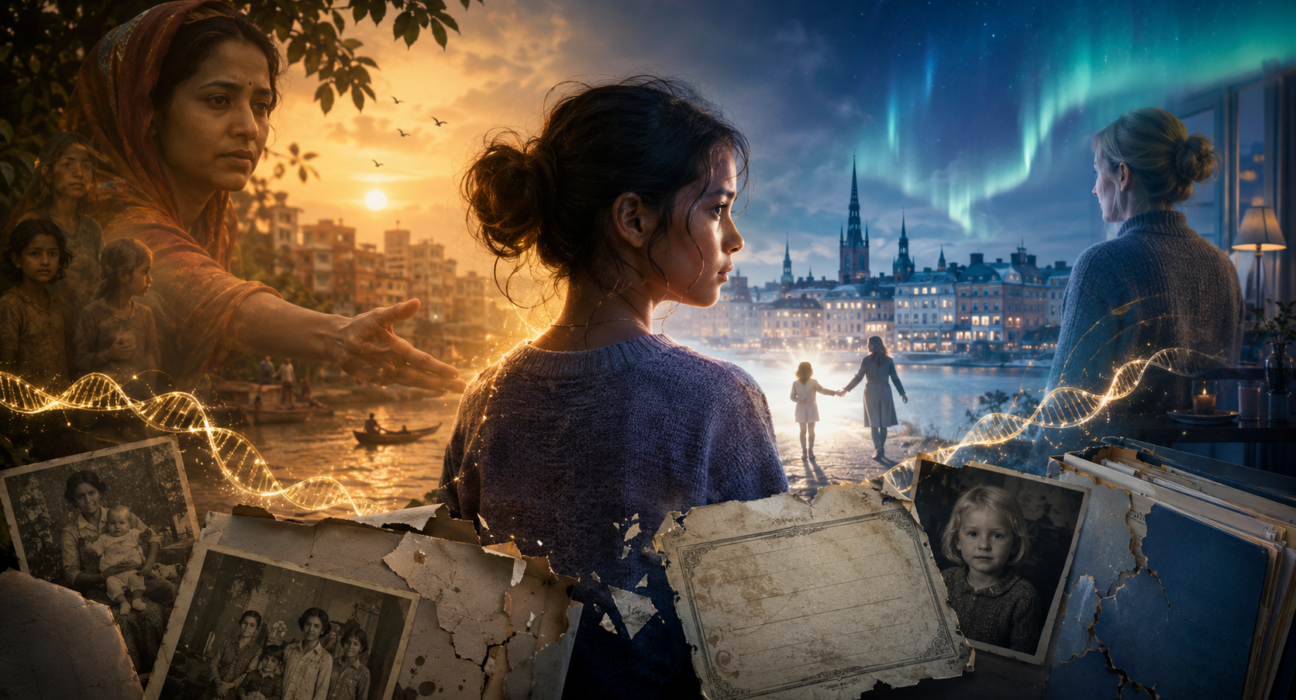
Born in Bangladesh and adopted to Sweden as a young child, Nordgren has spent decades searching for her biological roots while confronting missing records, contradictory information, institutional silence, and unresolved questions surrounding her origins. In 2025, after decades of uncertainty, DNA testing confirmed her biological relationship with her mother and relatives in Bangladesh, leading to a long-awaited family reunification.
Scott Douglas Jacobsen interviews Sofia Nordgren about why children are taken through irregular international adoptions and how adoptees experience the aftermath. Nordgren identifies poverty, war, stigma, demand from wealthier countries, and financial incentives as recurring conditions enabling exploitation. She emphasizes that emotional justice requires accurate records, birth certificates, original names, institutional guidance, family-search support, communication assistance, and public education so adoptees can reclaim identity, history, and connection despite unresolved loss across borders, generations, and continents.
Scott Douglas Jacobsen: One of the major questions surrounding children who are taken unlawfully concerns the justifications offered by those responsible. In your own case, there are still more questions than answers. However, in many other cases, the individuals involved are known and their motivations have been documented.
Based on what you have learned through your own experience and through conversations with others, what patterns do you see in the reasons given for taking children away from their families? The central question is why this happens. Another important question is how it feels for the people affected by it.
Do we have any indication as to why children are taken and trafficked across borders into different countries? And what is the emotional impact on those whose lives are shaped by these experiences?
Sofia Nordgren: I have spent a great deal of time thinking about these questions, and I have done my own research as well.
From what I have learned, there are multiple incentives involved. One major factor is money. Another is that people often take advantage of vulnerable situations, especially in poor countries or countries affected by war.
When you look at the history of international adoption, many large adoption movements emerged in the aftermath of conflicts such as the Korean War. In Bangladesh, for example, the Liberation War took place in 1971. In these situations, there may be abandoned children, war babies, children born as a result of rape, or children whose circumstances are stigmatized because of social or religious norms.
In some societies, unmarried women with children face severe social pressure. As a result, there are many different pathways through which children become vulnerable.
At the same time, there are other interests involved. Based on my research and understanding, financial incentives have played an important role in many adoption systems.
There is also a strong demand for children in wealthier countries. I live in Sweden, so I often speak from the Swedish perspective, but the phenomenon extends across many Western countries and beyond.
Organizations involved in international adoption have historically responded to a significant demand from prospective adoptive parents. Many families desperately want children but cannot have biological children of their own, or they face other barriers to parenthood.
Historically, the narrative presented to adoptees and the public was often that these systems were performing a humanitarian service, rescuing orphaned or vulnerable children and giving them better opportunities in life.
However, there is also a difficult question about the cost of achieving that goal.
I know how much my adoptive parents paid for my adoption, and they were not wealthy people. They were ordinary, middle-income individuals. Even in the 1970s, it was a substantial amount of money.
If you look at adoption costs today, the sums involved can be even larger. International adoption often requires very significant financial resources.
Because of that, there are strong incentives throughout the system. There is demand from receiving countries. There are organizations that facilitate adoptions. There are intermediaries involved at different stages of the process. Wherever large sums of money are involved, there is the potential for exploitation and corruption.
From my perspective, that combination of vulnerability, demand, and financial incentives creates conditions in which unethical practices can occur. That does not mean every adoption is unethical, but it does help explain why irregularities, falsified records, and allegations of child trafficking have emerged in so many different countries and contexts.
In my view, money is a major factor. Financial incentives exist throughout the system.
In Bangladesh, where I was born, international adoptions were halted in 1982 after concerns emerged about illegal adoptions. Authorities became aware of problems within the system, and eventually the practice was stopped. Adoption was also complicated by religious considerations, as traditional interpretations of Islamic law do not recognize adoption in the same way that many Western countries do.
From what I have learned through reading research and speaking with experts, financial incentives appear repeatedly in discussions about irregular or illegal adoptions. That pattern emerges across many countries and many different historical contexts.
Jacobsen: Even if we set aside questions of legal justice or financial compensation, what can provide something like emotional justice? What can help someone who has gone through this experience feel that some degree of fairness has been restored? If the truth is acknowledged, the history documented, and institutions provide support, what offers emotional sustenance even when legal or financial justice is unavailable?
Nordgren: That is a complex question because nothing can truly give me back the fifty years I spent separated from my biological family.
However, there are things that could help heal some of the trauma and address some of the unanswered questions.
I would like to see governments, both in receiving countries and countries of origin, provide practical, emotional, and financial support for adoptees searching for their histories. That support could include assistance in locating biological relatives, accessing documents, obtaining records from orphanages, and retrieving files from ministries or agencies involved in adoption processes.
I would also like help navigating these complex systems. Many adoptees do not know where to begin. The records are scattered across multiple institutions, countries, and bureaucracies. Having knowledgeable people who can guide adoptees through that process would make a significant difference.
Another important aspect is helping families reconnect and communicate. Finding biological relatives is only the beginning. People need support in establishing relationships, overcoming language barriers, and creating meaningful connections after decades of separation.
Documentation is also important. Knowing as much as possible about what happened, who was involved, and how decisions were made matters deeply. I would love to have my original birth certificate. I would love to know my original name with certainty.
For many adoptees, emotional justice is not only about finding biological relatives. It is also about restoring identity. It means having access to truthful information, original documents, names, dates, family history, and cultural belonging. Many adoptees spend decades trying to reconstruct pieces of their lives that others have always taken for granted.
In my own case, finding my biological mother through DNA was profoundly important. After decades of uncertainty, missing records, contradictory information, and unanswered questions,DNA testing confirmed our biological relationship with a very high degree of certainty.” . Yet even after reunion, many questions remain unanswered. Emotional justice is therefore not simply about discovering the truth. It is also about being supported in understanding, processing, and living with that truth.
These may seem like basic facts that many people take for granted, but for adoptees they can be profoundly important.
When I traveled to Bangladesh in 2025, I remember speaking with a journalist and a manager at BRAC. At times, they seemed surprised by the number of questions I was asking. They did not fully understand why I cared so much about details such as my birth name or exact date of birth.
That experience showed me how much education is still needed, both in receiving countries and in countries of origin. Many people do not fully understand what adoption means from the perspective of the adopted person.
For me, knowing these facts is not simply about curiosity. It is about identity. It is about understanding who I am, where I come from, and how my life unfolded.
Access to accurate information, acknowledgment of what happened, and support in uncovering the truth would not erase the past. However, they would help many adoptees feel more grounded, more understood, and more at peace with their own histories.
Jacobsen: That is a good answer. Thank you very much for the opportunity and your time, Sofia.
Scott Douglas Jacobsen is a contributor to The Washington Outsider. He is the Founder and Publisher of In-Sight Publishing (ISBN: 978–1–0692343; 978–1–0673505) and Editor-in-Chief of In-Sight: Interviews (ISSN: 2369–6885). He writes for International Policy Digest (ISSN: 2332–9416), The Humanist (Print: ISSN, 0018–7399; Online: ISSN, 2163–3576), Basic Income Earth Network (UK Registered Charity 1177066), Humanist Perspectives (ISSN: 1719–6337), A Further Inquiry (SubStack), Vocal, Medium, The Good Men Project, The New Enlightenment Project, The Washington Outsider, rabble.ca, and other media. His bibliography index can be found via the Jacobsen Bank at In-Sight Publishing comprised of more than 10,000 articles, interviews, and republications, in more than 200 outlets. He has served in national and international leadership roles within humanist and media organizations, held several academic fellowships, and currently serves on several boards. He is a member in good standing in numerous media organizations, including the Canadian Association of Journalists, PEN Canada (CRA: 88916 2541 RR0001), Reporters Without Borders (SIREN: 343 684 221/SIRET: 343 684 221 00041/EIN: 20–0708028), and others.