
by Scott Douglas Jacobsen and Irina Tsukerman
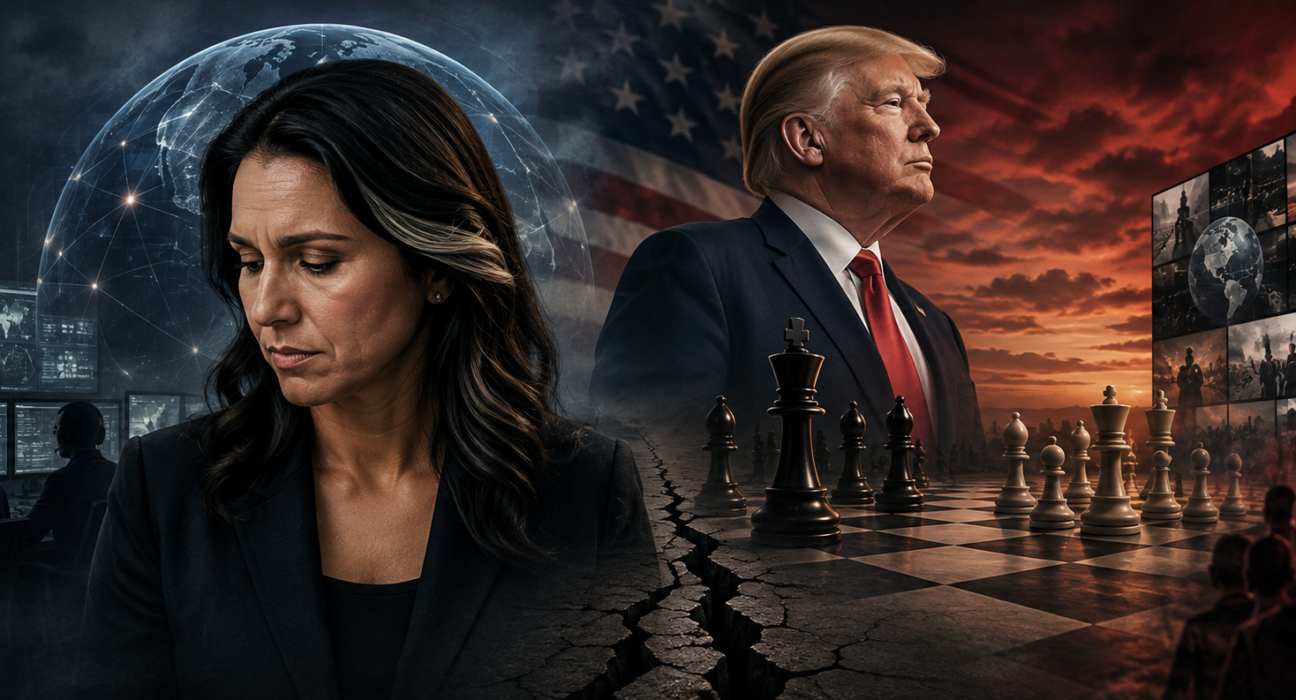
How does Tulsi Gabbard’s resignation reveal deeper issues in U.S. intelligence, Trump-era governance, and global media attention bias?
Irina Tsukerman is a human rights and national security attorney based in New York and Connecticut. She earned her Bachelor of Arts in National and Intercultural Studies and Middle East Studies from Fordham University in 2006, followed by a Juris Doctor from Fordham University School of Law in 2009. She operates a boutique national security law practice. She serves as President of Scarab Rising, Inc., a media and security strategic advisory firm. Additionally, she is the Editor-in-Chief of The Washington Outsider, which focuses on foreign policy, geopolitics, security, and human rights. She is actively involved in several professional organizations, including the American Bar Association’s Energy, Environment, and Science and Technology Sections, where she serves as Program Vice Chair in the Oil and Gas Committee. She is also a member of the New York City Bar Association. She serves on the Middle East and North Africa Affairs Committee and affiliates with the Foreign and Comparative Law Committee.
Scott Douglas Jacobsen and Irina Tsukerman examine Tulsi Gabbard’s resignation, arguing it exposes deeper dysfunction in U.S. intelligence coordination and politicization. They contrast superpower media dominance with neglected crises like Mali, while critiquing Trump’s chaos-driven governance strategy. Tsukerman emphasizes structural weaknesses and global impact disparities, while Jacobsen highlights media sensationalism and cultural patterns of political rise and fall. Together, they frame a broader critique of geopolitical signaling, institutional erosion, and distorted public discourse.
Scott Douglas Jacobsen: For Statecraft and Faultlines this week, this will come out shortly, the immediate tone of international news seems to have been set by the resignation of Tulsi Gabbard, the U.S. Director of National Intelligence, effective June 30, 2026. Publicly, the reason given is her husband Abraham Williams’s rare bone-cancer diagnosis, though there are also reports of political tensions around her tenure. When the person overseeing the U.S. intelligence community resigns abruptly, particularly amid major international conflict, that is significant.
From the Russian side, we are seeing business as usual: disinformation campaigns, militarized political theatre, and the familiar Kremlin emphasis on scale, menace, and spectacle. It is presentation as policy. It is not demure austerity; it is ostentation with a security doctrine.
The Chinese, meanwhile, have been quieter in tone, though not inactive. Foreign Minister Wang Yi is scheduled to chair a high-level UN Security Council meeting in New York on May 26, 2026, and then visit Canada from May 28 to 30.
From the Ukrainian side, there are many developments regarding the direction, the vector, for justice, aligning more and more with the human rights record. The overall frame remains straightforward: the aggressor state is the Russian Federation; the defender state is Ukraine.
I am having some trouble pulling a single thread out of that, but I am noting this: when a traditional superpower has even one individual making an abrupt about-face, it becomes front-page news for the largest agencies in the world. By contrast, in the Malian case, Defence Minister Sadio Camara was killed in coordinated insurgent attacks on April 25, 2026. It was reported, but with far less sustained global attention. No offense to Malians. That is simply how the hierarchy of attention operates.
This happens in Canada as well. George Carlin’s It’s Bad for Ya was his final HBO special, first televised in March 2008. The joke, broadly speaking, works because Canada can burn to the ground in the North American imagination and still somehow be treated as weather, not history.
Americans can take the heat, so to speak. So my commentary this week frames the question as follows: the meeting point of geopolitics and media is that when something happens in a superpower, it becomes front-page news, even if it involves a single individual shifting position. When it is the killing of a major state official in Mali, it is reported, but it does not tend to dominate the front page. There are clear consistencies in how the status of a country determines its newsworthiness in the eyes of leading agencies.
Irina Tsukerman: Well, I think it is a little bit more than just status. I would say it is also about impact. Because the United States is involved in so many international dimensions, intelligence collaboration in particular, any high-level cabinet position in the U.S. is almost like an entire government in some smaller, less globally engaged countries.
Mali, at present, sits near the bottom of the influence ladder. It is one of the poorest countries in the world. It is also led by a Russian-backed junta, and it has distanced itself from various African and Western institutions, becoming less integrated into international structures. At the same time, it is in the midst of an internal crisis, facing jihadist insurgencies and separatist pressures. Quite frankly, many continental African issues are treated as secondary in global discourse, except when they intersect with critical minerals or major geopolitical competition among superpowers.
They are seen as lacking broad systemic impact on international affairs. The Malian defense minister, in particular, given Mali’s isolation from France, the United States, and other Western institutions, is not viewed as especially influential in the grand scheme of things. Of course, terrorism, refugee flows, and humanitarian crises do affect the international community. That is all true. But as an individual news item, it does not register in the same way as something tied to the U.S. national security apparatus.
There is also a parallel debate in the United States about whether the position itself, the Office of the Director of National Intelligence, retains real relevance. Especially under the Trump administration, Tulsi Gabbard appeared to have been sidelined from some top-level discussions, including those related to Iran and other key foreign policy issues, where she was perceived as misaligned with the administration’s priorities.
Criticism of the ODNI structure predates Gabbard. There have long been arguments about whether the office does anything beyond managing the constellation of intelligence agencies, roughly 18 of them, without possessing sufficient independent authority to justify its existence. Some view it as an additional bureaucratic layer, a “coalition of coalitions.”
That said, a coordinating function can be important. Many of these agencies have overlapping mandates, sometimes drifting from their original purposes, and legal or political barriers often complicate information-sharing. Streamlining that flow, while avoiding conflicts of interest, is a legitimate institutional need.
Gabbard, however, was not widely regarded as the most effective Director of National Intelligence. She lacked the political weight and intelligence background of someone like John Negroponte, who helped establish the role. Her tenure was controversial. She promoted investigations into claims such as U.S. biolabs in Ukraine, and she was, somewhat unusually, present at an FBI raid, an involvement that did not clearly align with the traditional remit of her office.
Much of her public posture involved criticizing administration policy from the sidelines, which was also unusual for someone tasked with managing intelligence rather than shaping foreign policy. All of this made her role in the Trump administration appear awkwardly defined. Many questioned what she substantively contributed beyond political signaling to disaffected former Democrats who followed her into supporting Trump.
Whether that translated into measurable electoral impact in 2024 remains unclear.
So yes, her departure is major news because of the position. But the more important question is what comes next. Will the office itself be diminished or even abolished, as some have advocated? Will Trump appoint someone more closely aligned with his priorities? Will the role remain vacant, as has happened with other positions in his administration? Or will a successor actually strengthen coordination and produce meaningful intelligence outcomes?
These questions are emerging not because the intelligence world has fundamentally changed, but because the Trump administration appears to have narrowed its focus. Intelligence functions have been reoriented toward domestic concerns, the Western Hemisphere, and crime-related issues, rather than traditional foreign intelligence and counterintelligence operations.
At the same time, while agencies like the NSA continue cyber operations, particularly in relation to China, there has been confusion around broader U.S. cybersecurity strategy, including reports that elements of it have been deprioritized. Whether that reflects a shift in priorities, internal disagreement, or something else is not entirely clear.
What is clear is that there is a degree of disarray in how intelligence is being conceptualized and used. Questions remain about politicization, coordination with allies, and whether intelligence is effectively informing policy, or simply being filtered to support predetermined decisions.
None of this is resolved by Gabbard’s resignation. But her departure is forcing these underlying questions to surface more clearly than before.
Jacobsen: That has already been a year and a half, too. I did look at some of the records of confirmed crimes or charges associated with George W. Bush, George H. W. Bush, Bill Clinton, Richard Nixon, and Donald Trump, both his first and current terms. As far as I can tell, there is an approximate equivalence between Bush Jr.’s record and Trump’s across both terms, though with another two and a half years ahead, that may change. But the clear top-tier case, in terms of criminal exposure, remains Nixon, and it is not even close.
We now have far more reportage, and far more immediate reportage, particularly through social media, which amplifies public sensitivity to these issues, whether they are actual crimes, incompetence, self-dealing, or something in between. It is not unreasonable that when rapid resignations of top officials occur in an administration already known for controversy and a revolving door of staff, the first assumption leans toward misconduct, fraud, or at least poor judgment and lack of decorum.
From a media perspective, that also feeds into the “juiciness” of the story, the sense that the narrative is almost too compelling for the public to resist. Americans have a long-standing cultural pattern: they build figures up, almost like a golden calf, and then take equal pleasure in tearing them down. The arc is familiar. Elevation, then sacrifice.
There is a biblical echo to it, Christ casting demons into swine, for instance, followed by destruction. Whether one uses pigs, goats, or any symbolic stand-in, the underlying pattern holds. Figures are elevated within the culture, political or celebrity, and then sacrificed on the altar of drama. That sensibility is deeply embedded.
Tsukerman: In the case of Donald Trump, he is doing a great deal of that himself. The sheer number of scandals associated with him are, to a significant extent, self-inflicted. Yes, there has been political opposition, some of it questionable, especially early in his political career, but over time, many of the public concerns about his behavior in office have proven to be well-founded.
There is even growing unease among some of his supporters about the level of impunity and gall with which he approaches public office, treating it, at times, like a personal instrument for financial and political gain, while disregarding norms, laws, and institutional boundaries. It often appears as though the primary motivation for entering office was to accumulate power sufficient to pursue personal ambitions and interests, with governance itself as a secondary function.
Much of his time in office has been spent shaping his image, reinforcing his legacy, expanding financial advantages, and planting long-term seeds for influence and institutional control. Many of the actions currently being taken would traditionally have been labeled as dangerous, abusive of power, or even authoritarian.
For example, the consolidation of media influence among political and business allies, when undertaken by Democrats, was widely criticized. When similar dynamics occur under Trump, they are sometimes reframed as corrective measures for the media landscape. That inconsistency reflects a deeply distorted way of interpreting political reality.
It becomes difficult to determine whether this is genuine belief, rooted in naivety, grievance, or selective perception, or whether it is a form of rationalization, a way of remaining aligned with a political figure in the absence of viable alternatives.
The issue is not simply whether Trump should be rejected, but that many supporters do not perceive a credible alternative to rally behind. There is no “magic solution.” For years prior to Trump’s rise, there had been a steady accumulation of grievances, cultural, political, economic, and he emerged as a figure who seemed to promise resolution.
But now, not only have many of those issues remained unresolved, some have worsened. And those who once promoted him as the answer are left without a clear explanation. Their remaining option, in many cases, is to double down, to insist that what is evidently flawed is, in fact, successful.
Jacobsen: For autocratic states, the least wise approach in this environment is probably what we are seeing from the Russian Federation: overt bluster, theatrical escalation, and highly visible signaling. The wiser approach, from an authoritarian perspective, is usually to do very little publicly while continuing quiet, below-the-radar operations, closer to the Chinese model.
So this kind of bluster still speaks to the existence of a relatively open media environment, but it also reflects poor signaling from the administration, especially given that it is approaching the midpoint of a second term.
Tsukerman: A great many of the problems this administration is facing right now are self-inflicted, and, in many cases, deliberately so. Part of the objective appears to be the creation of noise and chaos themselves. First, because Donald Trump has always thrived in chaotic environments and public controversy, and second, because he seems to require public adulation at someone else’s expense. That dynamic has long appeared central to his political and personal style.
I do not think Trump is comfortable unless someone else is being humiliated, discarded, or positioned as the loser. The Apprentice was built entirely around those sentiments, and he carried the same model into business and then into the White House.
The scandals we are seeing are not incidental or accidental; they often appear structurally embedded in the political strategy itself. Critics and analysts have repeatedly described this as a “flood the zone” approach, creating such a constant stream of controversy, conflict, and spectacle that accountability becomes difficult to sustain.
I do not think the objective was ever traditional governance in the sense of solving problems methodically and building stable institutional outcomes. The objective seems instead to be entering the fray dramatically, gaining support for “taking on” issues others avoided, and then either leaving the consequences to future administrations, blaming political enemies, or reframing unresolved situations as victories before quickly moving on to the next conflict.
That approach also serves another purpose: distraction. Chaos obscures scrutiny. While public attention is focused on Iran, Cuba, Venezuela, Greenland, Canada, or whichever controversy dominates the cycle that week, attention is diverted away from questions of power accumulation, financial interests, influence networks, and institutional erosion.
Jacobsen: Yes, and as you can probably tell from Canadian news stories, we remain a deeply terrifying internal threat to the United States at this speed.
These terrifying Canadians, armed with their terrifying politeness. I mean, if Alberta were hypothetically to become the 51st state, the Americans would not just be importing Alberta, they would also be importing more American-style problems into Alberta. That includes greater exposure to violent crime, polarization, and some of the social pathologies already far more prevalent in the United States than in Canada.
The irony is that Canadian anxieties about the United States are usually less about conquest and more about cultural absorption. Canadians do not generally imagine America invading us with tanks; we imagine being slowly annexed by algorithms, chain restaurants, and cable news panels. Which is, admittedly, a very Canadian fear.
Tsukerman: I think the people driving this discourse are not really concerned with the underlying problems. In fact, I do not think they are concerned with long-term issues at all. Quite frankly, U.S. prosperity is being directly undermined at the moment by Trump’s policies and by the erosion of U.S. credibility.
But I think the Alberta group pushing for this is not focused on those second-order effects. They are looking for a short-term advantage, aligning with Trump at what they perceive to be a critical moment, extracting whatever benefits they can, and then effectively riding off into the sunset, leaving everyone else to deal with the consequences.
Jacobsen: That is actually a good ending line. Alright, I will see you next week.
Tsukerman: Thank you.
Scott Douglas Jacobsen is a contributor to The Washington Outsider. He is the Founder and Publisher of In-Sight Publishing (ISBN: 978–1–0692343; 978–1–0673505) and Editor-in-Chief of In-Sight: Interviews (ISSN: 2369–6885). He writes for International Policy Digest (ISSN: 2332–9416), The Humanist (Print: ISSN, 0018–7399; Online: ISSN, 2163–3576), Basic Income Earth Network (UK Registered Charity 1177066), Humanist Perspectives (ISSN: 1719–6337), A Further Inquiry (SubStack), Vocal, Medium, The Good Men Project, The New Enlightenment Project, The Washington Outsider, rabble.ca, and other media. His bibliography index can be found via the Jacobsen Bank at In-Sight Publishing comprised of more than 10,000 articles, interviews, and republications, in more than 200 outlets. He has served in national and international leadership roles within humanist and media organizations, held several academic fellowships, and currently serves on several boards. He is a member in good standing in numerous media organizations, including the Canadian Association of Journalists, PEN Canada (CRA: 88916 2541 RR0001), Reporters Without Borders (SIREN: 343 684 221/SIRET: 343 684 221 00041/EIN: 20–0708028), and others.