
by Giovanni Giacalone
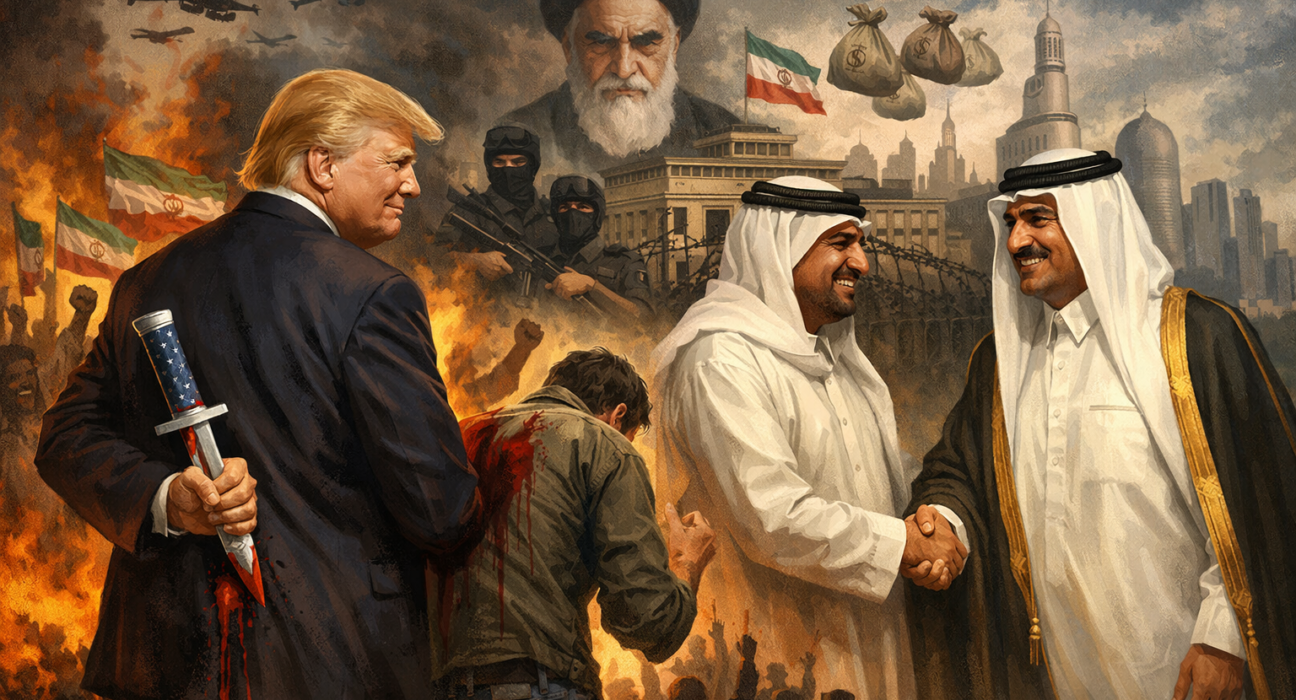
The US President Donald Trump is at it again. The first time, he betrayed the Iranian people by inciting them to demonstrate and “take over the institutions”, promising a “help” that never arrived. He first threatened the regime with retaliation if it kept slaughtering demonstrators and then, he backed off, stating that he had no interest in attacking Iran and even praising the regime for allegedly “stopping the executions”.
However, the information coming from Iran told a very different story, with thousands being massacred and even the doctors treating the demonstrators being apprehended by security forces. In the meantime, the regime also hunted down anyone attempting to circumvent the internet blackout, fearing that videos documenting the atrocities might reach the outside world.
Why did Trump believe the tale? Firstly, wishful thinking. Trump loves to present himself as the “deal-maker” and the “peace-maker”. In fact, he even believes that “we have peace in the Middle East.” No matter if the Kurds in Syria are slaughtered, if the Iranian people are slaughtered, if Hamas still hasn’t disarmed (and is not going to), if Hezbollah is still a threat to Israel, and if Ahmed al-Shaara’s jihadists are killing minorities in Syria.
Secondly, because Special Envoy Steven Witkoff informed him so, after receiving a message from Iranian Foreign Minister Abbas Araghchi.
Yes, Witkoff, the same one who claimed that the Trump administration prefers a diplomatic resolution to the Iranian tensions, rather than a military one. The same one who had “a moment of emotional connection” with Hamas leader, Khalil al-Hayya, in October 2025, and who put his hand on his heart while shaking hands with Putin in Moscow.
Witkoff and son are also known for their strong business ties with Doha to the extent that the US and Israeli media have raised concerns of a potential conflict of interest.
And who, if not Qatar and Turkey, share a great interest in saving the Iranian regime from collapse, considering that they are openly trying to isolate Israel in the Middle East. Who could best safeguard such an interest within the White House? Indeed, the US Special Envoy, Steven Witkoff, flanked by Jared Kushner and US Ambassador to Turkey, Thomas Barrack.
And here’s the second time Trump has betrayed the Iranians, moving a gargantuan armada to the Middle East, destabilizing the region, once again raising the hopes of the oppressed Iranians just to pull the brakes once again and claim to be open for negotiations on a nuclear deal. And who is working to organize a meeting with the Iranians this week in Ankara? Witkoff, Qatar, and Turkey, indeed.
Unlike many would like to believe, Trump’s inconsistency and contradicting positions on Iran are not part of a strategy, they are simply chaos. They reflect conflict within the US administration and make everyone wonder who is really running the White House’s foreign policy, Trump or Qatar?
Considering that the US has a Secretary of State called Marco Rubio, why is his job being carried out by Witkoff and Kushner?
The answer may once again be “Qatar” and, in this regard, it is worth recalling one more issue. On January 13, 2026, the US Department of the Treasury’s Office of Foreign Assets Control designated the Lebanese, Egyptian and Jordanian branches of the Muslim Brotherhood, for their material support to Hamas, as Specially Designated Global Terrorists (SDGT).
However, the measures taken by Washington against the Muslim Brotherhood do not include the movement’s two main state-sponsors, Qatar and Turkey, which are also the two major Hamas supporters. What’s the point in limiting the sanctions to the branches active in Lebanon, Jordan and Egypt, also considering that in the latter two states, the Muslim Brotherhood is already outlawed?
Going back to the Iranian issue, Trump’s flimsy threats do not weaken the regime; on the contrary, they strengthen it by highlighting the US inconsistency and by presenting the idea of a stoic regime standing up against the US armada that Trump is afraid to use due to an alleged destabilization (which is already occurring through Trump’s empty threats anyway).
On January 15, 2026 an Iranian journalist in exile, Masih Alinejad, speaking at the emergency meeting of the United Nations Security Council, said: “The Iranian people are asking the world to help through action, not back-to-back meetings and empty condemnations. We don’t need empty words.”
On January 31, 2026, during an interview on Israel’s Channel 12 News, US Ambassador to Israel Michael Huckabee said: “This is a president who has made many promises; you’ll be hard-pressed to find one that he hasn’t kept…He doesn’t make empty threats.”
Unfortunately, the Iranian demonstrators who were slaughtered while waiting for that help that was “on its way” and never came will not be able to agree, nor will their relatives.
So far, the outcome of the Iranian issue is a disaster and represents a devastating blow to both Trump’s personal reputation and his administration, no matter what he and his supporters wish to believe, because reality does not forgive.