
By Talgat Kabdygali
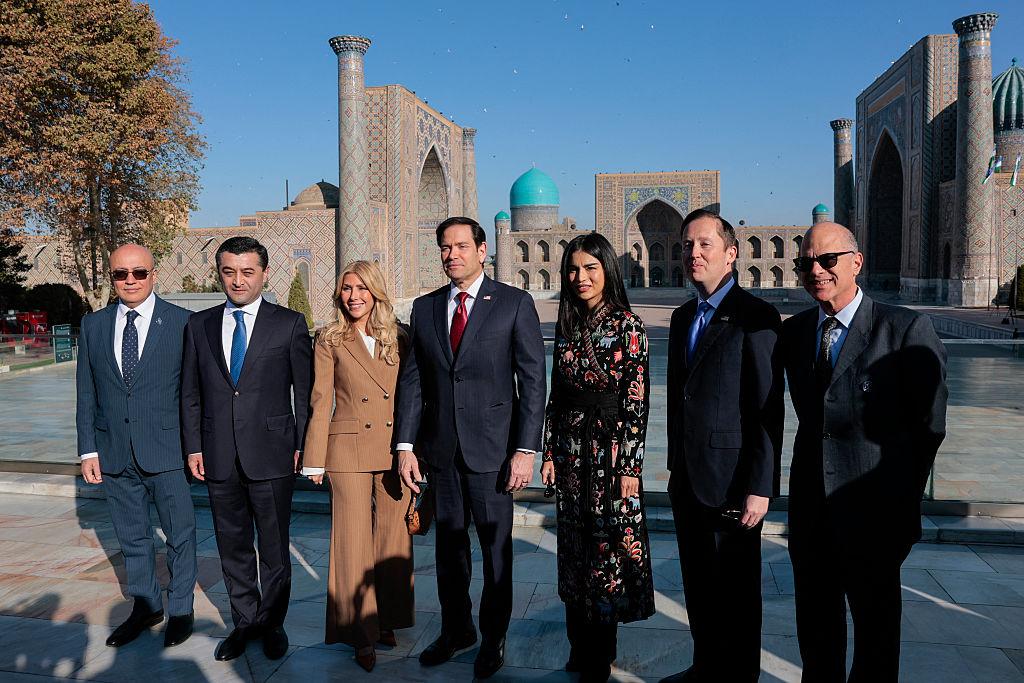
U.S. Secretary of State Marco Rubio’s October 18–19, 2026 visit to Samarkand, Uzbekistan, marked a further expansion of Washington’s diplomatic and commercial engagement with Central Asia. Accompanied by more than 200 American business representatives, Rubio participated in the C5+1 ministerial meeting and held discussions focused on investment, critical minerals, infrastructure, and regional security. The visit followed the November 2025 C5+1 presidential summit in Washington, where more than $25 billion in commercial agreements and commitments were announced. These developments indicate an increasingly economic orientation in American regional policy, although significant structural obstacles remain.
KEY ISSUE
Washington is attempting to translate its renewed diplomatic engagement with Central Asia into a durable commercial presence, particularly in critical minerals, transportation, and advanced technologies. While competition with China provides an important strategic incentive, the United States faces considerable challenges arising from geography, established regional economic relationships, and the limited availability of alternative infrastructure. For Kazakhstan and Uzbekistan, the central issue is whether American investment can support industrial diversification rather than reinforce existing commodity-export models. The outcome will depend less on diplomatic declarations than on the implementation of commercial agreements, technology transfer, and the ability of regional governments to negotiate economically advantageous partnerships.
BACKGROUND
The C5+1 framework was established in Samarkand in November 2015, when then-U.S. Secretary of State John Kerry met with the foreign ministers of Kazakhstan, Kyrgyzstan, Tajikistan, Turkmenistan, and Uzbekistan. Initially, the mechanism emphasized regional security, counterterrorism, economic cooperation, and environmental challenges. Its development was closely associated with Washington’s broader strategic interests in Afghanistan and the surrounding region.
The withdrawal of American forces from Afghanistan in 2021 significantly altered the geopolitical context. Without a direct military presence in Afghanistan, Washington faced the challenge of redefining its engagement with Central Asia beyond the security priorities that had shaped much of its earlier policy.
Subsequent developments created new incentives for American involvement. Russia’s war against Ukraine disrupted established economic relationships, while intensifying U.S.–China competition increased Washington’s interest in diversifying strategic supply chains.
The C5+1 mechanism subsequently gained greater political visibility. President Joe Biden hosted the first presidential-level C5+1 summit in New York in September 2023. President Donald Trump hosted the five Central Asian presidents in Washington in November 2025, placing particular emphasis on commercial cooperation.
According to the U.S. Department of Commerce, commercial agreements and commitments announced around the November 2025 summit exceeded $25 billion. These included aircraft purchases, industrial equipment, railway infrastructure, and mineral development. However, the headline figure incorporated different types of transactions and prospective commitments, making it an imperfect measure of actual investment.
Several agreements nevertheless demonstrated tangible commercial interest.
Kazakhstan’s Tau-Ken Samruk and American company Cove Capital agreed to develop the Severny Katpar and Verkhne Kairakty tungsten deposits. The proposed $1.1 billion project includes processing plants and metallurgical facilities, potentially extending cooperation beyond raw-material extraction.
Aviation agreements also featured prominently. Air Astana announced arrangements covering up to fifteen Boeing 787-9 aircraft, while Uzbekistan Airways finalized an additional order for eight Dreamliners.
Rubio’s Samarkand visit built upon this commercial agenda. His delegation included representatives of major American corporations and financial institutions, including Boeing, Citibank, and Franklin Templeton.
On October 19, Rubio acknowledged that Central Asia had received insufficient attention from American policymakers over the preceding two decades. His remarks suggested an intention to institutionalize commercial engagement rather than treat the visit as an isolated diplomatic initiative.
IMPLICATIONS
The most significant strategic dimension of Washington’s renewed interest concerns critical minerals and the restructuring of global supply chains.
China maintains a dominant position in the processing of several minerals essential to advanced manufacturing, electronics, defense technologies, and energy systems. For the United States, dependence on concentrated processing capacity represents an economic and national security vulnerability.
Central Asia offers potential alternatives, although the region’s contribution will depend on investment in extraction, processing, transportation, and technological capabilities.
Kazakhstan possesses substantial uranium, copper, tungsten, and other mineral resources. Its position as a major global uranium producer already gives it an important role in international energy markets. Uzbekistan is simultaneously expanding its mining sector and seeking additional foreign investment.
However, the economic benefits of mineral development depend on the structure of individual projects.
Exporting unprocessed minerals generates revenue but captures a relatively limited portion of the industrial value chain. Processing facilities, metallurgical operations, technical training, and associated manufacturing can create more durable economic benefits.
The proposed Cove Capital–Tau-Ken Samruk tungsten project is therefore significant because it includes downstream industrial facilities. Its eventual implementation could provide an indication of whether American investment will support industrial development or remain concentrated in resource extraction.
A second implication concerns the changing diplomatic relationship between Kazakhstan and Uzbekistan.
Uzbekistan has increasingly positioned itself as a venue for high-level international engagement. In April 2025, Samarkand hosted the first EU–Central Asia summit, during which the European Union announced a €12 billion Global Gateway investment package covering transportation, energy, critical raw materials, and digital connectivity.
The October 2026 C5+1 meeting further strengthened Samarkand’s visibility as a regional diplomatic center.
Kazakhstan, meanwhile, maintains a larger established economic relationship with the United States. According to U.S. government trade figures reported in October 2026, bilateral trade in goods and services reached approximately $7.1 billion with Kazakhstan in 2025, compared with $1.7 billion with Uzbekistan.
These differences should not necessarily be interpreted as evidence of emerging geopolitical rivalry. Kazakhstan’s mineral resources, financial infrastructure, and transportation networks complement Uzbekistan’s demographic advantages, expanding domestic market, and industrial ambitions.
Regional coordination could improve both countries’ ability to negotiate with international investors, particularly in infrastructure projects requiring cross-border cooperation.
A third implication concerns the limits of American economic influence.
Despite growing interest from Washington, Russia and China remain deeply integrated into Central Asia’s economic geography. Russia maintains extensive energy and transportation connections, while China plays a major role in regional trade, infrastructure, and investment.
Rubio acknowledged these constraints during his October 19 remarks in Samarkand, emphasizing that geography makes it difficult for some countries to obtain alternative energy supplies.
This recognition suggests that American policy may increasingly emphasize diversification rather than demanding the replacement of existing regional partnerships.
The Trans-Caspian International Transport Route, commonly known as the Middle Corridor, illustrates the practical challenges.
The route connects Central Asia to European markets through the Caspian Sea, Azerbaijan, Georgia, and Türkiye. Its expansion could reduce dependence on individual transit corridors while strengthening regional economic connectivity.
Nevertheless, its competitiveness depends on port infrastructure, railway capacity, customs coordination, shipping costs, and the reliability of cross-border logistics.
American diplomatic support could encourage investment, but sustainable development requires commercially viable projects and cooperation among transit states.
Finally, the effectiveness of Washington’s strategy will depend on institutional continuity. American commercial initiatives must compete with established Chinese financing arrangements and longstanding regional business networks.
Large delegations and announced agreements may generate political momentum, but their strategic value will ultimately be determined by financing, implementation, and measurable economic results.
CONCLUSIONS
Rubio’s Samarkand visit reflects an increasingly commercial approach to U.S. engagement with Central Asia. Critical minerals, industrial investment, and transportation connectivity have become central components of Washington’s regional agenda, complementing its traditional security interests.
However, the United States is unlikely to displace Russia or China as major economic partners in the foreseeable future. Geographic constraints, established infrastructure, and existing commercial relationships limit the prospects for rapid strategic realignment.
For Kazakhstan and its neighbors, the opportunity lies in using renewed American engagement to diversify investment sources, strengthen domestic processing industries, and expand international market access.
The strategic significance of Samarkand therefore extends beyond the immediate objectives of American diplomacy. It highlights the growing capacity of Central Asian states to engage multiple external partners while pursuing their own economic priorities.
The ultimate measure of success will not be the number of diplomatic meetings or announced agreements, but whether these partnerships produce lasting industrial capabilities and greater regional economic autonomy.
AUTHOR’S BIO
Talgat Kabdygali is a Harvard University graduate in Government and co-founder of Numen Intelligence. His research focuses on U.S. foreign policy, international security, and Central Asian geopolitics. His commentary has appeared in The Times of Central Asia, Daryo, and other international publications.