
By METHAQ ALMASHRAQY
What is happening in Aden and Riyadh is no longer a local skirmish. In recent weeks, tactics have changed by targeting civilian infrastructure, including repeated strikes on civilian airports and civilian facilities. This represents a dangerous shift in the rules of engagement. When conflict moves from military fronts to airports and civilian cities, it ceases to be a Yemeni issue and becomes a regional and international security threat.
In this context, the recent decision of the Egyptian National Defense Council must be read. The Council announced its full solidarity with Saudi Arabia, considering Saudi security is an integral part of Egyptian and Arab national security, pledging to provide all necessary and possible forms of support to defend the stability of the Kingdom and the safety of its territories.
On paper, this is a natural expression of a historic Egyptian-Saudi alliance. But on the ground, repercussions are much more complex. Any direct Egyptian military involvement, even if described as defensive and at the request of Riyadh, risks expanding the conflict. Instead of extinguishing the fire, this decision may spread it. The group will no longer look at Cairo as a neutral party, but as a party to the conflict. Their doctrine has always been to retaliate where it hurts most. Therefore, we may see a new front extending from the Red Sea to Cairo, and perhaps beyond, to areas already targeted by long-range missiles in recent months.
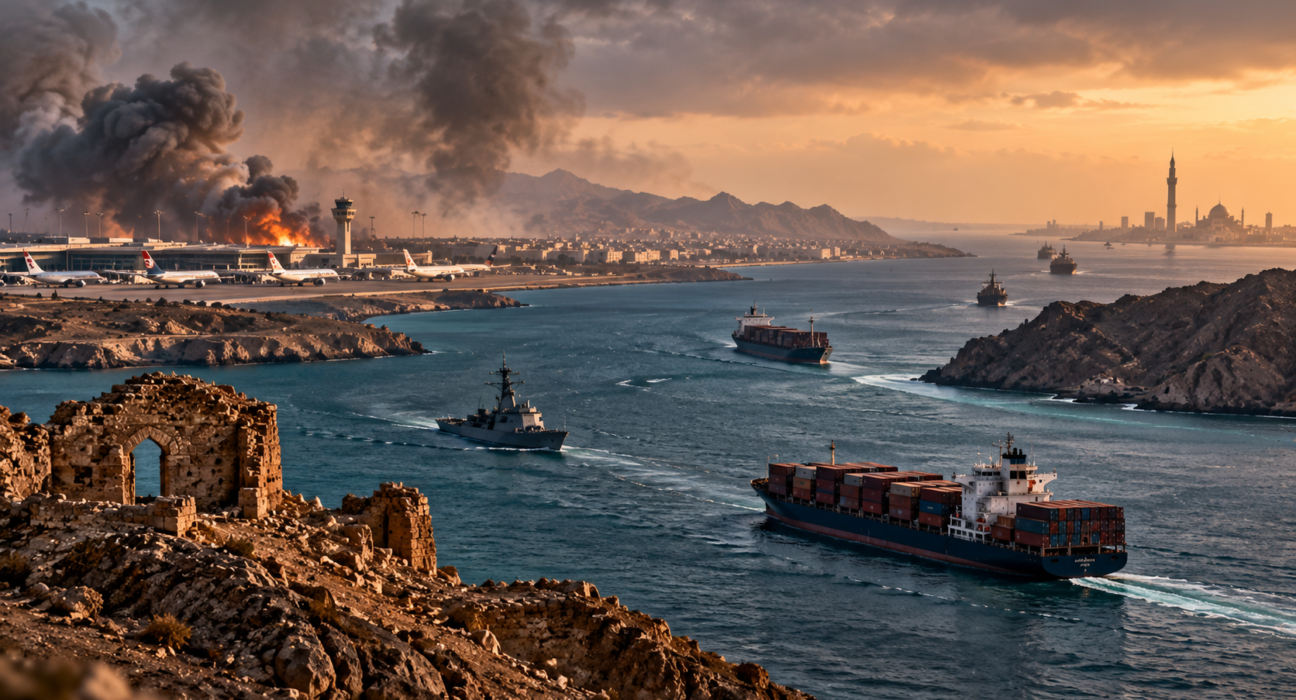
The most urgent danger lies in the threat to international navigation and global trade that passes through Bab al-Mandab. The group has previously proven its ability to disrupt shipping using booby-trapped boats, drones, and anti-ship missiles. If it now feels besieged by a new Egyptian-Saudi front, Bab al-Mandab will become the main theater for retaliation. Any major disruption will lead to almost complete paralysis of maritime traffic, huge rise in shipping insurance premiums, and diversion of global trade around the Cape of Good Hope. The price will be paid by the whole world.
And there is a point many analysts overlook: The Suez Canal will not be safe from retaliation. If Bab al-Mandab is the mouth, the Suez Canal is the artery. Any attack in the southern Red Sea directly reflects on Canal revenues. This puts Egyptian economy in the line of fire. Egyptian economy does not allow Cairo to engage in costly military alliances. Egypt is struggling with external debts. Therefore, engaging in a new war means economic exhaustion, decline in tourism, and sharp drop in Suez Canal revenues, which are the two main sources of hard currency.
For Yemen, especially the South, economic impact will be devastating. Aden depends entirely on its port. Disrupting Bab al-Mandab means strangling Aden port, stopping imports, raising prices of food and medicine, and accelerating collapse of what remains of local currency. The citizen in Aden and Hadramout will pay price double. Regionally, effects will extend to Saudi Arabia and Egypt, with Suez Canal revenues and global oil and energy prices affected.
For this reason, military solution is an illusion. Every experience from 2015 until today has proven that decisive victory by force is impossible. What we need now is not more alliances, but serious international pressure for de-escalation. Washington and the European Union must pressure all parties to favor reason and dialogue under genuine international sponsorship. Instead of encouraging escalation, there must be immediate halt to targeting civilians and return to negotiating table.
At the heart of any sustainable dialogue must be a just political solution for the South. One cannot talk about securing Bab al-Mandab and stability in Yemen without addressing the legitimate Southern cause and recognizing the right of Southerners to restore their state and determine their future. The South is the actual guarantor of this waterway. Its people secure the coast and pay price for chaos. Ignoring this truth and turning crisis into proxy war between Cairo and Riyadh on one side and Sanaa on the other will only lead to more destruction.
The immediate requirement is a ceasefire, stopping attacks on civilian infrastructure, and comprehensive dialogue that includes all stakeholders. If this is neglected and crisis is managed through military alliances alone, waters of Bab al-Mandab may become an uncontrollable flashpoint, with consequences far beyond Yemen.
Bio: Independent journalist from Al-Dhalea, Yemen, 10 years field experience. Published in Aden Al-Ghad, Al-Sadarah Sky, Aden Observer, Al-Seyassah Kuwaiti. Focus: Red Sea security.