
by Gilles Touboul
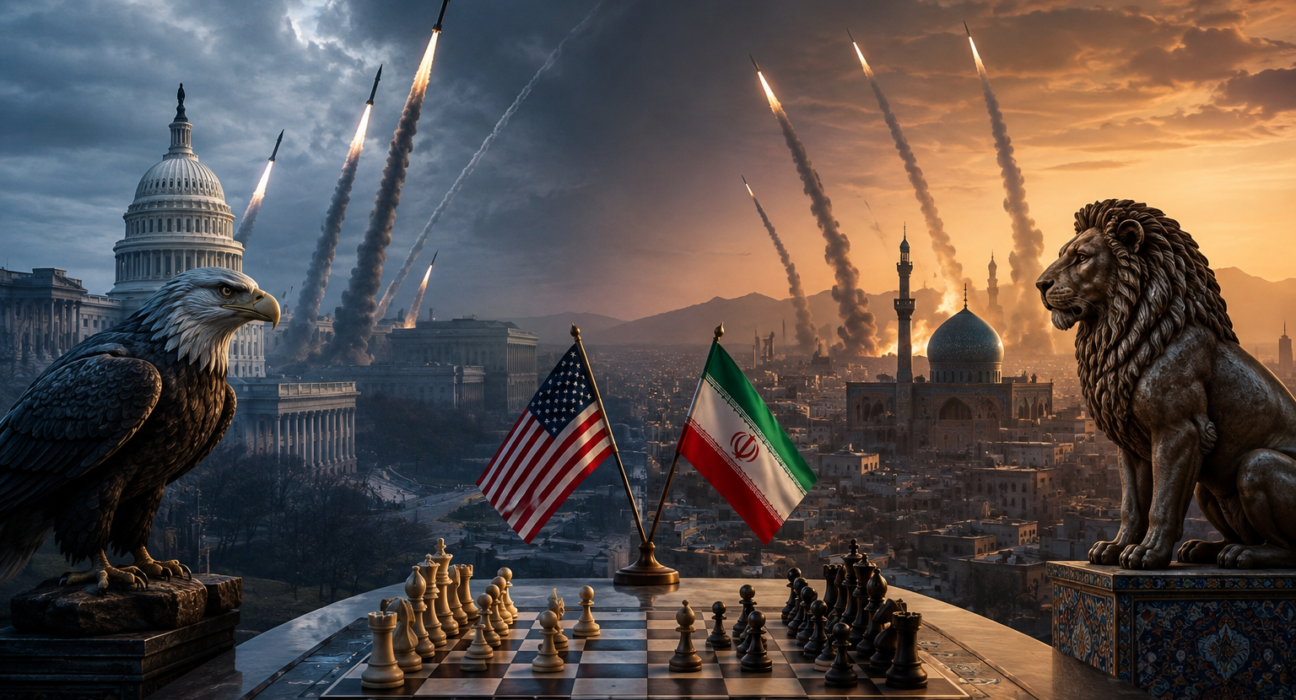
How can two powers continue to negotiate while striking each other? The question may seem absurd. It is not. In international relations, war and diplomacy are not always distinct; very often, they move forward together. Diplomacy speaks. Missiles punctuate. Negotiators talk. Armies adjust the balance of power.
This is what we are seeing today between Washington and Tehran.
After new American strikes on Iranian territory, Iran responded by targeting facilities linked to American forces in several Gulf countries. Yet the talks are not officially dead. Mediators continue to call for de-escalation, and technical channels remain open. The paradox is clear: both sides are striking, but neither seems willing to slam the door on negotiations completely.
This situation can be viewed through several lenses.
The first lens is coercion. For Washington, striking Iran may be a way to remind that negotiations will not happen under Iranian threat. America wants to show it is not intimidated by attacks on ships, bases, or energy routes. It wants to regain the initiative. It wants to impose a cost on Tehran. In this logic, military strikes are not the end of diplomacy. They are a message sent before the next diplomatic sentence.
But this logic carries a risk: it may reinforce the Iranian belief that Washington wants a deal, but only after humiliating Iran. Tehran, however, cannot accept talks while appearing to be on its knees.
The second lens is Iranian. For Tehran, retaliating against sites linked to American forces in the Gulf achieves various objectives. First, to show that Iran is not passive. Second, to remind that American security in the region also depends on the vulnerability of its bases, allies, and maritime routes. Finally, to turn the crisis into a regional problem. If Qatar, Kuwait, Bahrain, or other Gulf States become exposed, these countries will have an interest in pressing Washington toward de-escalation.
This may be the Iranian calculation: not to defeat the United States militarily, which is impossible, but to make the political cost of escalation too high.
The third lens is the trap. Iran may seek to put America in a dilemma. If Washington strikes again, it risks widening the war and alarming its allies. If Washington does not strike, it may appear to be backing down. In both cases, Tehran tries to turn American superiority into strategic embarrassment. This is a classic method of weaker powers: not confronting the adversary’s force directly, but forcing it to pay the political price for using it.
The fourth lens concerns Donald Trump. The American president wants to appear strong. He wants to show that America does not suffer passively. But he also wants to avoid a long, costly, unpopular, and market-destabilizing war. This is the American ambiguity: strike hard enough to be credible, but not so hard as to become trapped in total war. Diplomacy under missiles then becomes a strategy of dosage. Too little force weakens deterrence. Too much force destroys negotiation.
The fifth lens is that of the allies. Israel watches this sequence with particular concern. On one hand, American strikes confirm that Washington remains capable of acting against Iran. On the other hand, maintaining diplomatic routes shows that the United States does not necessarily want to go all the way with Israeli logic. America wants to contain Iran. Israel may want to weaken it more permanently. The difference is important.
The Gulf monarchies are in an even more delicate position. They host American forces but do not want to become the first victims of an American-Iranian confrontation. They need American protection although fear that it will also attract Iranian missiles. Their message will likely be twofold: not to break with Washington but to press for rapid de-escalation.
The sixth lens is the Strait of Hormuz. The strait is not simply a maritime route. It is a political weapon. Iran knows it is able to unsettle markets without completely closing the passage. It only needs to create doubt, slow flows, multiply incidents, and raise the risk premium. Again, the goal is not necessarily to cause the collapse of global trade. The objective is to remind that Iran has a disruptive capacity disproportionate to its real military power.
This is why this crisis is so dangerous. Both sides may believe they control escalation. Washington thinks it can strike without triggering total war. Tehran thinks it can respond without provoking massive destruction. But history shows that wars do not always spiral from intent. Sometimes, they spiral from error, misreading, accident, or overconfidence.
A missile that kills too many American soldiers. A strike near a nuclear site. An attack on a civilian ship. An interception mistake. Domestic pressure forcing a leader to respond more strongly than anticipated. This is how diplomacy under missiles can become war without diplomacy.
There are therefore three possible scenarios.
First scenario: controlled de-escalation. Both sides strike once or twice more, then use mediators to return to a technical compromise. Each can say it did not give in. Washington will say it restored deterrence. Tehran will say it responded. Gulf allies will press to close the crisis.
Second scenario: limited but lasting escalation. Negotiations officially continue, but attacks become regular. This creates a gray war: neither peace nor total war. Markets get used to the tension, but the risk remains permanent. This is probably the most unstable scenario, as it normalizes violence.
Third scenario: rupture. A strike causes too many victims or hits a symbol that is too important. One side decides it can no longer back down. Military logic overtakes diplomatic logic. At that point, mediators lose their influence, and war becomes much harder to contain.
The heart of the problem is simple: Washington and Tehran use force to improve their negotiating position. But the more they use force, the more they undermine the space where negotiation can still exist.
That is diplomacy under missiles.
It rests on a dangerous contradiction: convincing the other to return to the table while showing that refusal will be very costly. This method can work. But it requires perfect control of timing, targets, messages, and perceptions. Yet in the Middle East, perception is often more explosive than reality.
The real question is not just: who strikes the hardest?
The real question is: who will turn force into a political outcome?
Because a power does not win simply by destroying a target. It wins when it forces the adversary to accept a new balance. If missiles only produce a new series of reprisals, then they are no longer an instrument of diplomacy. They become proof that diplomacy has failed.
Washington and Tehran are therefore engaged in an extremely fragile sequence. Each wants to speak from a position of strength. But each risks discovering that by speaking with missiles, one sometimes ends up unable to speak at all.