

by Mohammed Salem Mujawar
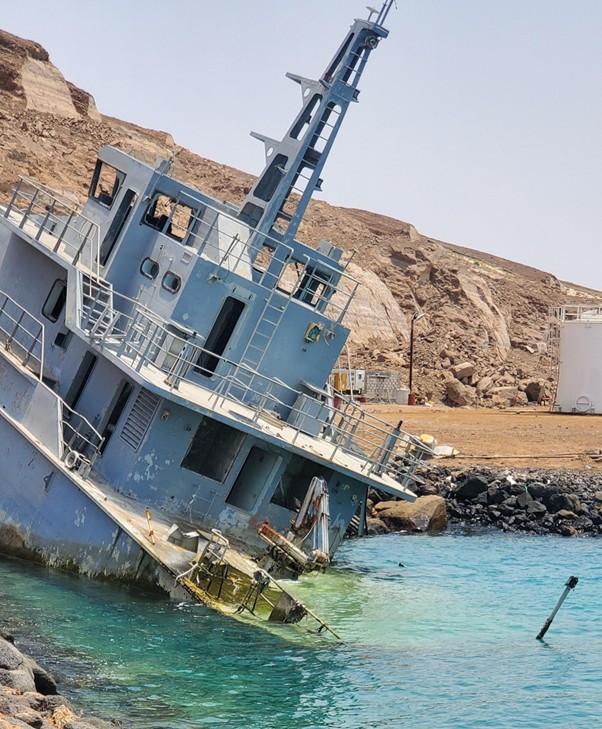
“An Australian-built patrol boat, formerly belonging to the Yemeni Navy and Coastal Defense Forces, lies sunken and abandoned near the Qena port in Shabwah Governorate. This vessel was once part of the fleet tasked with protecting gas tankers belonging to the French company Total. Today, it rests as rusted wreckage—a silent witness to the systematic ‘claw-clipping’ operation inflicted upon the Yemeni Navy after 2012, and to the sovereignty vacuum now consuming the security of the Arabian Sea.”
Photo Credit: Mohammed Salem Mujawar
On May 2, 2026, as the region was in the midst of the height of the “war over energy corridors”—with the Strait of Hormuz nearly completely closed and threats returning to the Bab el-Mandeb Strait—the oil tanker “Eureka” was sailing in the Gulf of Aden when its automatic identification system suddenly went silent. This was not a technical malfunction, but rather an armed hijacking off the coast of Shabwah Governorate, following which the tanker was seized and headed toward the Somali coast. The Yemeni Coast Guard announced the incident in a statement, only for it to vanish into the horizon amid a deadly maritime sovereignty vacuum.
The Arabian Sea and the Gulf of Aden are not peripheral waters. They are the maritime crossroads through which passes over 10% of global trade, 30% of Europe’s oil imports, and the vital sea lanes linking the Mediterranean to the Indian Ocean. What happens here does not stay here.
Interpreting this news as merely a “piracy crime” is strategic naivety, for this incident is not an exception but rather evidence of a deeper strategic crime that reminds us of the onset of Somali piracy in early 2000 and the subsequent schemes that were thwarted by the institutional resilience of the Yemeni Navy at the time, which served as a bulwark of national sovereignty and a key player patrolling the Red Sea and the Arabian Sea. Today, however, the danger lies in the Yemeni state’s absence from its waters and the dismantling of its naval capabilities, paving the way for the permanent internationalization and militarization of the Arabian Sea. The hijacking of the Eureka is a stark declaration that there are those who profit from chaos and those who pay the price for the absence of the “claws” that once protected this sea in the recent past.
When Yemen Was an Impenetrable Shield: Major General Mujawar… The Architect of the Seas… and the Chartmaker of the Shipping Lanes During the Blockade
To understand the gravity and danger of what happened to the tanker Eureka, we must look back to a time when Yemen was a “solution” rather than a “problem.” A decade and a half ago, under the command of Rear Admiral Ruwais Abdullah Ali Mujawar, who led the Naval Forces and Coastal Defense between 1999 and 2012, Yemen was not issuing distress calls but was an equal partner commanding respect in international operations rooms.
During that golden era, the “Mujawar Doctrine” was embodied in the realization that sovereignty over the sea is not granted in forums, but is seized through capabilities, combat doctrine, and national spirit. Under his leadership, achievements emerged that we are compelled to mention:
During that “golden age,” Yemen possessed “eyes that never sleep” through the construction of an advanced coastal radar system that provided a live “operational picture” of Yemen’s maritime border—from Ras Isa in Hodeidah to Sarfit near Oman in Al-Mahra Governorate—enabling the leadership to see before acting.
Through his relentless pursuit, Yemen was able to establish a deterrent capability, manifested in the development of a modern fleet of patrol boats and rapid-deployment vessels, transforming the Navy from a symbolic force into a rapid-response force capable of pursuit and engagement on the high seas.
He worked with a team spirit and was loved by commanders and soldiers alike, securing victories for Yemen that were more than just statements; these forces were not merely ink on paper, but fought decisive battles. When the Yemeni oil tanker “Artin” was hijacked off the coast of Shabwah, they did not wait for a foreign fleet; instead, the Navy moved in, surrounded the hostile boats, and freed the tanker. And when the tanker “Dukhan” was attacked in international waters, the Yemeni Navy confronted the attackers and thwarted the assault. These facts confirm that the “claws” were sharp and effective.
Through his diplomacy, his proactive reading of events, his participation in international forums and conferences, and his visits to key stakeholders, Mujawar was able to transform the Yemeni Navy into a central strategic pillar and an effective force that earned the international community’s trust in protecting commercial ships and giant oil and gas tankers in the Red Sea and the Arabian Sea, through continuous patrols and constant escort.
“This legacy was not a luxury, but rather the backbone of national sovereignty in the world’s most dangerous waterways.”
From Disintegration to the Trap: Creating a Vacuum to Justify International Intervention
The painful and strategic question: How did we go from liberating “Artin” to waiting for “Eureka” to be seized and hauled in like a sardine on a desperate fisherman’s hook? The answer: After 2012, the Yemeni Navy and Coastal Defense Forces were subjected to a systematic “claw-clipping” operation: their infrastructure was destroyed, their readiness reduced to zero, and their qualified personnel—on whose training and qualification “gold was spent”—were dispersed and marginalized. The painful irony is that death claimed the lives of those devastated personnel, who witnessed the fate of the institution they had built brick by brick. Our country was transformed—willingly or by force—from a sovereign maritime state into a nation with “exposed coasts.”
And herein lies the greatest strategic trap: this vacuum we see today is not merely bad luck or negligence, but rather a “manufactured” reality serving the agendas of internationalization. For when the Yemeni state is stripped of its military and legal tools to operate in its territorial and international waters, it grants the major powers a “moral and legal pretext” to intervene. The absence of the Yemeni Ministry of Defense and the National Navy legitimizes the presence of foreign fleets and transforms the Arabian Sea into an “international zone of operations” subject to the calculations of the major powers and their energy security.
In short, we have fallen into the trap… we are legally, militarily, and operationally constrained, while international forces are practically present, filling a vacuum created for them to occupy. The hijacking of the “Eureka” is the bitter fruit of this geopolitical engineering, and it marks the beginning of international domination over our seas and shores.
Conclusion: Reviving Major General Mujawar’s Doctrine… A Battle for Survival, Not Luxury
The hijacking of the “Eureka” is not a distress call to foreign fleets but a wake-up call for Yemen and the region. As recent history has proven, the solution will not come from “blue helmets” or naval alliances that further militarize the sea and rob us of our autonomy, but rather from restoring the spirit embodied by Major General Mujawar: “The spirit of national sovereignty lies in the resolve of men… not in the presence of the national treasury!”
What the Minister of Defense must do now is to assert Yemen’s presence through “information and operational capabilities,” then proceed to reorganize and rebuild the Navy and Coastal Defense Forces and revive their combat doctrine—not as a military luxury, but as a battle for national survival. It is the battle between being an “open waterway” managed by the agendas of major powers, and being a “maritime wall” guarded by the people of Yemen with their hearts before their hands. And if Yemen does not reclaim its naval “claws,” our sea will remain a theater of sovereignty violations, and every “Eureka” will continue to be hijacked, providing irrefutable proof that whoever holds the key to the security of energy corridors rules the world.