
by Scott Douglas Jacobsen and Irina Tsukerman
How do strategic overconfidence, shifting war aims, and artificial intelligence reshape the risks of quagmire in Iran and Ukraine?
Irina Tsukerman is a human rights and national security attorney based in New York and Connecticut. She earned her Bachelor of Arts in National and Intercultural Studies and Middle East Studies from Fordham University in 2006, followed by a Juris Doctor from Fordham University School of Law in 2009. She operates a boutique national security law practice. She serves as President of Scarab Rising, Inc., a media and security strategic advisory firm. Additionally, she is the Editor-in-Chief of The Washington Outsider, which focuses on foreign policy, geopolitics, security, and human rights. She is actively involved in several professional organizations, including the American Bar Association’s Energy, Environment, and Science and Technology Sections, where she serves as Program Vice Chair in the Oil and Gas Committee. She is also a member of the New York City Bar Association. She serves on the Middle East and North Africa Affairs Committee and affiliates with the Foreign and Comparative Law Committee.
Scott Douglas Jacobsen and Irina Tsukerman examine how strategic overconfidence and weak foresight can trap major powers in geopolitical quagmires. They compare Russia’s failed expectation of a quick victory in Ukraine with the shifting and uncertain objectives of the U.S.–Israel–Iran confrontation. Tsukerman argues that Iran is not yet a quagmire, but could become one without clear goals, long-term planning, and realistic force calculations. The discussion then turns to technological competition, especially artificial intelligence, asking whether war-damaged states can remain competitive during transformative eras. Tsukerman concludes that AI’s distributed nature allows Iran to compete informationally even when kinetically disadvantaged globally today.
Scott Douglas Jacobsen: In this session, we focus on foresight and the quagmires that can follow from making decisions within simplistic frameworks about matters that are, by their nature, highly complex, especially in geopolitics. There are too many variables.
Two major cases have been at the forefront of the news: the U.S.–Israel–Iran conflict and Russia–Ukraine.
In the longer-term case of Russia–Ukraine, the Kremlin appears to have expected a rapid seizure of Kyiv in the opening phase of the 2022 invasion, but that did not happen. Putin was widely reported to have been badly served by flawed assumptions and poor internal reporting about the war. Russia then failed in its attempt to take Kyiv and shifted the war to a longer conflict in the east and south. Russian losses have been enormous, and the war has killed hundreds of thousands of soldiers and civilians on both sides.
The war is still ongoing. As of mid-March 2026, Russia was claiming advances in parts of eastern and southern Ukraine, while Ukraine was also reporting that it had disrupted Russian offensive plans and regained territory in some sectors. My own experience here, however, is that there were fewer air raid alarms last week.
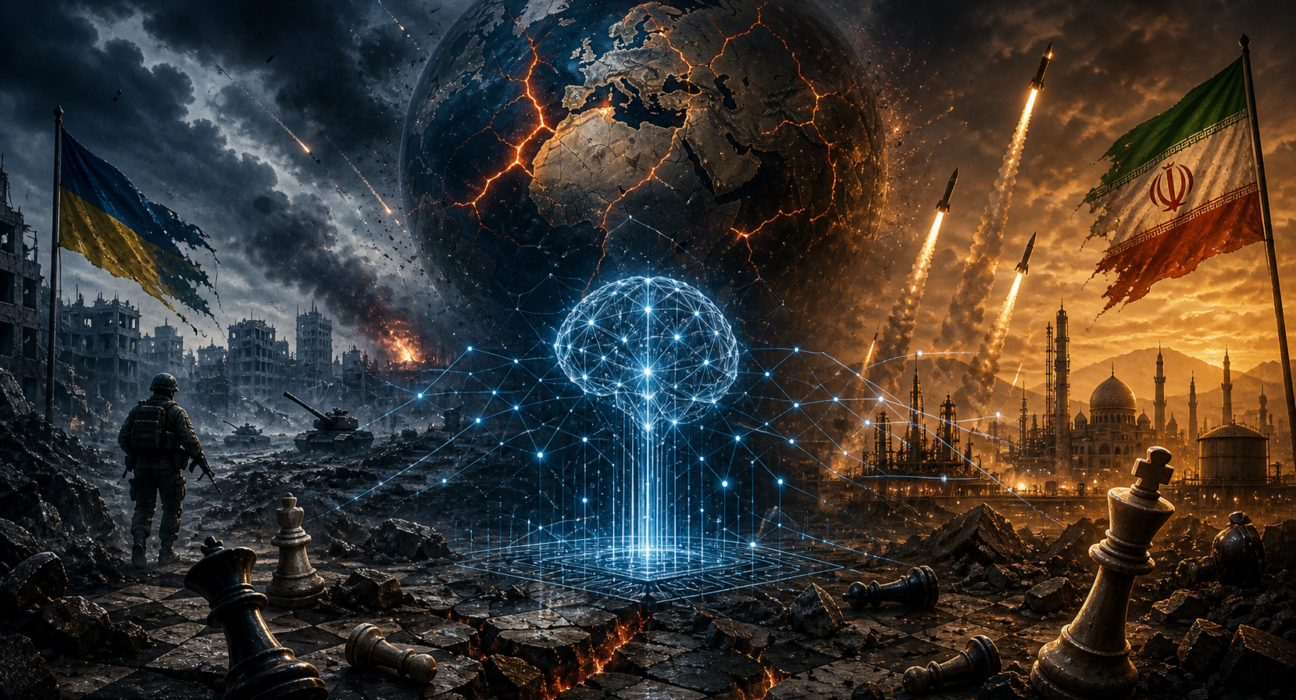
In the Iranian case, it is accurate to say that much of the senior leadership has been targeted. Reports have indicated significant strikes against senior figures and infrastructure. What is harder to state cleanly is the strategic objective. Publicly visible aims have appeared to shift among degrading Iran’s military capacity, targeting regime leadership, constraining its nuclear program, deterring retaliation, and forcing changes in Iranian behavior around the Strait of Hormuz. So the metaphor still works: they are playing chess on a board of turbulent water, with pieces made of smoke.
By contrast, in the Russian case, the broad aims have been more consistent: subordinating Ukraine, controlling territory, and forcing political concessions. Yet those aims remain only partially achieved after more than four years of war.
This overconfidence, and the lack of foresight grounded in that overconfidence, can lead even major powers into quagmires. It raises the question: under conditions of uncertainty, why do leaders make decisions that appear hasty, poorly informed, or only partially informed?
Irina Tsukerman: In Putin’s case, the answer is relatively straightforward. Putin appears to have been insulated from accurate information by advisers who were unwilling to tell him the truth about both the Russian military’s weaknesses and the likely scale of Ukrainian resistance. He seems to have expected a rapid victory, including the possibility that Ukraine’s government could be displaced quickly, and that the war would not become a prolonged, large-scale conflict. That was a profound miscalculation.
In Trump’s case with Iran, there are differences. He did not appear to have deep subject-matter knowledge of Iran, but he may have believed—or been advised—that decapitating a hostile regime’s leadership could produce a rapid strategic payoff. The Venezuela precedent may have encouraged that belief, because Nicolás Maduro was reportedly removed by U.S.-backed developments in January 2026 and Delcy Rodríguez became acting president. However, Venezuela’s repressive apparatus remained in place, so that case did not amount to a clean democratic resolution.
There was an acceptable political deal that did not require significant involvement of U.S. forces. Iran was a different case, but Trump appears to have believed that eliminating top-level leadership would bring Iran to the negotiating table and produce a transition similar to Venezuela. He would obtain an arrangement regarding oil and a temporary de-escalation of attacks on Israel and U.S. targets. That did not materialize due to a fundamental miscalculation and a misunderstanding of how the regime functions structurally and ideologically.
The original objective may have been a Venezuela-like transition to a more amenable leader. Instead, outcomes may produce leadership that is more dangerous, more ideologically driven, and less inclined toward negotiation.
With respect to whether Iran constitutes a quagmire, it is too early to say. It would not yet be accurate to describe it as such, particularly given U.S. military capabilities. However, the absence of a clear plan or objective is not promising. Without a defined goal, success is unlikely. U.S. goals appear to have shifted, and it is unclear whether those were the original objectives or evolved during the conflict.
At this stage, it appears increasingly likely that leadership decapitation alone will not suffice. If the objective involves control over energy resources, that could require occupation rather than a negotiated arrangement.
From a military standpoint, the United States may be capable of rapid action. However, taking territory and holding it are fundamentally different challenges. Iran has a population of approximately 90 million people. Even partial support for the regime would translate into millions capable of sustained resistance.
Any occupation would require sufficient forces, long-term planning, and a clear strategy for maintaining control. Targeting infrastructure such as Kharg Island could reduce oil revenue and constrain military financing, but it is unclear whether such measures are being planned or resourced adequately.
There are also policy contradictions. Efforts to restrict Iranian oil revenue have been paired with tolerance of continued activity by external shipping networks and adjustments to sanctions to stabilize global oil prices. These dynamics introduce economic and political complications.
If the conflict becomes prolonged without clear objectives, the United States could face domestic political challenges related to funding, congressional support, and electoral consequences.
There is no clear consensus on what constitutes success in Iran. For Israel, the objective is more defined: degrading Iran’s missile capabilities, nuclear program, and broader military capacity to reduce near-term threats. While not yet achieved, Israeli leadership appears to consider this attainable within a relatively short timeframe.
They can destroy launch sites and degrade enough of the program so that it does not pose a threat for an extended period. On the U.S. side, some of those goals may align, but it is not clear what additional military objectives exist or whether statements that the United States intends to destroy Iran’s ballistic missile program are accurate.
Everything I am hearing from non-partisan, objective experts suggests that the situation is highly fluid and unpredictable. It is impossible to determine with confidence what will happen next.
I think it is premature to claim victory, defeat, or a quagmire. Anyone making such claims is, at best, engaging in wishful thinking or advancing a particular narrative aligned with their objectives.
The United States will need to establish a formal structure and a long-term plan, depending on what it seeks to accomplish. Without that, there is a significant risk that this could become an open-ended quagmire, with resources continually drawn in because the United States failed at the outset to determine what level of force would be sufficient to decisively neutralize Iran’s capabilities.
Jacobsen: That raises an interesting broader point. When major global actors make large-scale decisions without foresight—that is, in a shortsighted manner—this can coincide with periods of technological transition.
Historically, we have seen phase changes, such as transitions between technological eras. In more recent history, the 1990s saw the dot-com boom-and-bust cycle.
In the contemporary period, we are seeing the development of large language models, often grouped under the label of artificial intelligence. More broadly, these systems—built on deep learning, neural networks, and related architectures—represent a significant technological shift, potentially extending toward artificial general intelligence.
If a society’s military or economic infrastructure is severely degraded at the same time that such technologies are emerging, it does not simply set that society back relative to its competitors. It may remove it from effective participation in the technological race altogether, particularly in the competition for talent and advanced systems.
In that sense, if Iran must simultaneously rebuild damaged infrastructure, it may lose access to, or the capacity to develop, these advanced technologies.
Are there comparable historical periods, whether contemporary or earlier, in which a society was significantly weakened by an adversary at the same time that transformative technologies were emerging, leaving it unable to remain competitive?
Tsukerman: I would point to the nuclear race during and after World War II. Japan was effectively removed from that competition due to the extent of its destruction. The Soviet Union, while it did become a nuclear power, accelerated its progress in part through extensive intelligence-gathering efforts targeting U.S. research.
Jacobsen: Yes, that is a good point. You are referring not only to the end of World War II in the Japanese case, but specifically to Hiroshima and Nagasaki. There is also another case I learned about: the industrialization of destruction through firebombing.
Many humanists are familiar with Kurt Vonnegut, a writer associated with the American Humanist Association. He survived the bombing of Dresden, which involved large-scale firebombing.
In Japan’s case, American firebombing created devastating firestorms. Bombing patterns were often designed to maximize spread: fires expanded outward and inward, generating intense heat and powerful updrafts. These conditions created firestorms in which temperatures rose dramatically, leading to mass destruction within affected areas.
This level of devastation—combined with the atomic bombings of Hiroshima and Nagasaki—contributed to Japan’s defeat and postwar demilitarization, which limited its immediate participation in major military competitions at that time. It is a relatively modern example, in the broader scope of human history, of a society being severely weakened during a critical technological moment.
There are likely many such cases, but I am thinking about the present context. Experts consistently emphasize the transformative power of artificial intelligence, particularly as advances in compute, energy supply, and algorithmic sophistication accelerate its development.
Tsukerman: Here is the key distinction. I agree that Iran could face a significant disadvantage due to infrastructural damage. However, artificial intelligence differs from earlier technologies in that it is not tied to a single physical location.
In other words, Iran can develop and deploy certain capabilities from distributed locations globally. To some extent, it already has, although in a different manner from the United States.
The United States and its allies have integrated AI into defense systems, such as precision-guided munitions and targeting systems, which provides a clear advantage in conventional, kinetic warfare. Iran cannot easily match that level of capability.
However, Iran has been conducting an aggressive information campaign using AI tools, including deepfakes and automated amplification of narratives. This has influenced discourse in parts of the Arab world and, to some extent, in Western countries.
Where Iran cannot prevail kinetically, it may seek to compete politically and informationally. That appears to be a central element of its strategy. Importantly, these activities are not dependent on geographic location; they can be conducted globally.
Iran also operates through companies and startups based in Europe. When registered as European entities and partnered with local actors, they are not always perceived as foreign-linked operations. This further complicates responses.
In that sense, the United States and its allies may have shown insufficient creativity in addressing some aspects of Iran’s capabilities.
Jacobsen: Thank you very much for the opportunity and your time, Irina.
Scott Douglas Jacobsen is a contributor to The Washington Outsider. He is the Founder and Publisher of In-Sight Publishing (ISBN: 978–1–0692343; 978–1–0673505) and Editor-in-Chief of In-Sight: Interviews (ISSN: 2369–6885). He writes for International Policy Digest (ISSN: 2332–9416), The Humanist (Print: ISSN, 0018–7399; Online: ISSN, 2163–3576), Basic Income Earth Network (UK Registered Charity 1177066), Humanist Perspectives (ISSN: 1719–6337), A Further Inquiry (SubStack), Vocal, Medium, The Good Men Project, The New Enlightenment Project, The Washington Outsider, rabble.ca, and other media. His bibliography index can be found via the Jacobsen Bank at In-Sight Publishing comprised of more than 10,000 articles, interviews, and republications, in more than 200 outlets. He has served in national and international leadership roles within humanist and media organizations, held several academic fellowships, and currently serves on several boards. He is a member in good standing in numerous media organizations, including the Canadian Association of Journalists, PEN Canada (CRA: 88916 2541 RR0001), Reporters Without Borders (SIREN: 343 684 221/SIRET: 343 684 221 00041/EIN: 20–0708028), and others.