
by Gilles Touboul
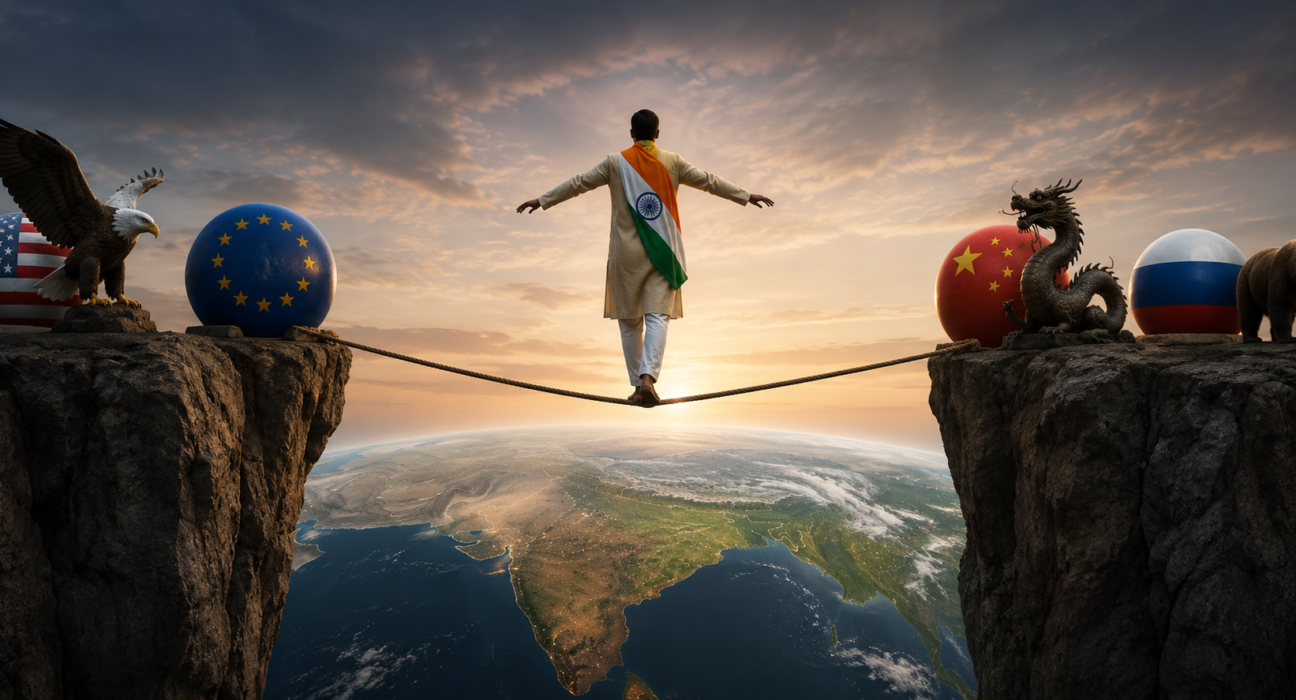
For a long time, India’s multi-alignment was seen as a strength. New Delhi could buy weapons from Russia, talk to Washington, remain inside the BRICS with China and Russia, take part in the Quad with the United States, Japan and Australia, and still present itself as the voice of the Global South.
This was India’s great diplomatic advantage: speaking to everyone, depending on no one, and refusing to be locked into one bloc.
Indian Foreign Minister S. Jaishankar often explains this logic clearly. India can be in the Quad, the BRICS, the SCO, speak with the G7, and still defend the interests of the Global South, because today’s world is no longer built only around fixed alliances. It is built around flexible coalitions, depending on the issue.
But this is also where the problem begins.
The stronger India becomes, the harder it is for India to remain ambiguous. A middle power can balance between several camps. A great power, sooner or later, must define its priorities.
India does not want to become a subordinate ally of the United States. But it needs Washington to balance China. India does not want to break with Russia. But Russia is moving closer and closer to Beijing. India wants to speak for the Global South. But its security interests are pushing it closer to the Western powers.
This is the Indian paradox.
The first pressure point is China.
For New Delhi, Beijing is not only an economic competitor. It is also a territorial, military and maritime rival. Chinese pressure in the Himalayas, its growing presence in the Indian Ocean, its links with Pakistan, its control of strategic supply chains and its ambitions in critical technologies all push India toward the United States, Japan, Australia and Europe.
This is why the Quad has become more important. Officially, India does not present the Quad as an anti-China alliance. But in reality, Beijing sees it as a tool of containment. China’s reaction to recent Quad meetings shows this clearly. When Beijing says that such cooperation should not target a “third party” or create exclusive blocs, it is because it understands the strategic message behind it.
The second pressure point is Russia.
For decades, Moscow was one of India’s most important military partners. A large part of India’s defense system still depends on Russian equipment, spare parts and technologies. But the war in Ukraine has changed the situation.
India still needs Russia, but it is also trying to diversify. It is buying more from France, Israel, the United States and other Western partners. This does not mean that India is abandoning Russia. It means that New Delhi knows the old model is becoming more risky.
Here we see one of the biggest limits of Indian strategic autonomy: India wants to be independent, but it is still dependent on foreign military suppliers. “Make in India” is a major ambition, but the reality is more complex. India is not yet fully self-sufficient in defense.
So India has room to maneuver, but it also has vulnerabilities.
Another weakness is the gap between diplomatic ambition and strategic capacity. India wants to speak as a civilizational power, a demographic giant, a technological actor and a military force. But in several decisive sectors, it still depends on others: Russian weapons, Western technologies, Gulf energy, American maritime protection and global supply chains that are still partly dominated by China. This does not make India weak. But it shows the limits of its autonomy. A country can refuse formal alliances, but it cannot escape material dependence. In this sense, Indian multi-alignment is not only a doctrine of freedom. It is also a way of managing constraints.
The third pressure point is Washington.
India does not want to become another Japan or South Korea, tied to the United States through a formal alliance. New Delhi refuses to be seen as a simple anti-China pawn in America’s strategy.
But at the same time, India needs the United States. It needs American technology, intelligence, naval cooperation, semiconductors, supply chains and support in the Indo-Pacific. This is the contradiction: the more India wants to remain free, the more it needs powerful partners. But the more it needs powerful partners, the less totally free it becomes.
This is the heart of the problem.
The fourth pressure point is the Global South.
India wants to be seen as the voice of countries that do not want to be dominated by the West, China or Russia. It wants to speak in the name of sovereignty, independence and non-alignment. This gives India a strong diplomatic identity.
But this position becomes harder to defend when India is also working closely with the Quad, seeking Western technologies, engaging with the G7, and moving closer to the American security architecture in Asia.
This is not a moral contradiction. It is a geopolitical contradiction.
India wants to be both the voice of the non-Western world and the key partner of the West in Asia. That balance is becoming more difficult.
The real weakness of India’s multi-alignment is therefore clear: it works well in a flexible world, but much less in a polarized one.
When great powers can still cooperate on some issues, India can move between them. But when the world becomes harder — United States against China, Russia against the West, tensions in the China Sea, energy insecurity, technological rivalry — every partnership becomes a political test.
The real question, therefore, is not whether India will choose the West, Russia or the Global South. The deeper question is whether it can continue to transform ambiguity into influence. For now, New Delhi benefits from being courted by everyone. But this advantage may gradually become a burden. The United States will ask for clearer commitments against China. Russia will expect political loyalty. The Global South will expect India to resist Western pressure. And China will treat every Indian move as a hostile signal. India’s challenge is no longer simply to stay balanced, but to prevent balance from becoming paralysis.
This does not mean that India’s strategy has failed. On the contrary, it has been very useful. It allowed India to gain time, protect its options, avoid dependence on one camp, and increase its value in the eyes of all major powers.
But India is now entering a more difficult phase.
It is becoming too powerful to remain neutral on everything, but not yet powerful enough to impose its own rules alone.
India will not abandon strategic autonomy. It will continue to make it the center of its diplomacy. But this autonomy is no longer absolute freedom. It is becoming a permanent exercise in balance.
Indian multi-alignment is not dead. But it is becoming more costly, more risky and more contradictory.
India wanted to avoid choosing between blocs. But today’s geopolitics is imposing a harder reality: you can speak with everyone, but you cannot depend on everyone at the same time.