
by Gilles Touboul
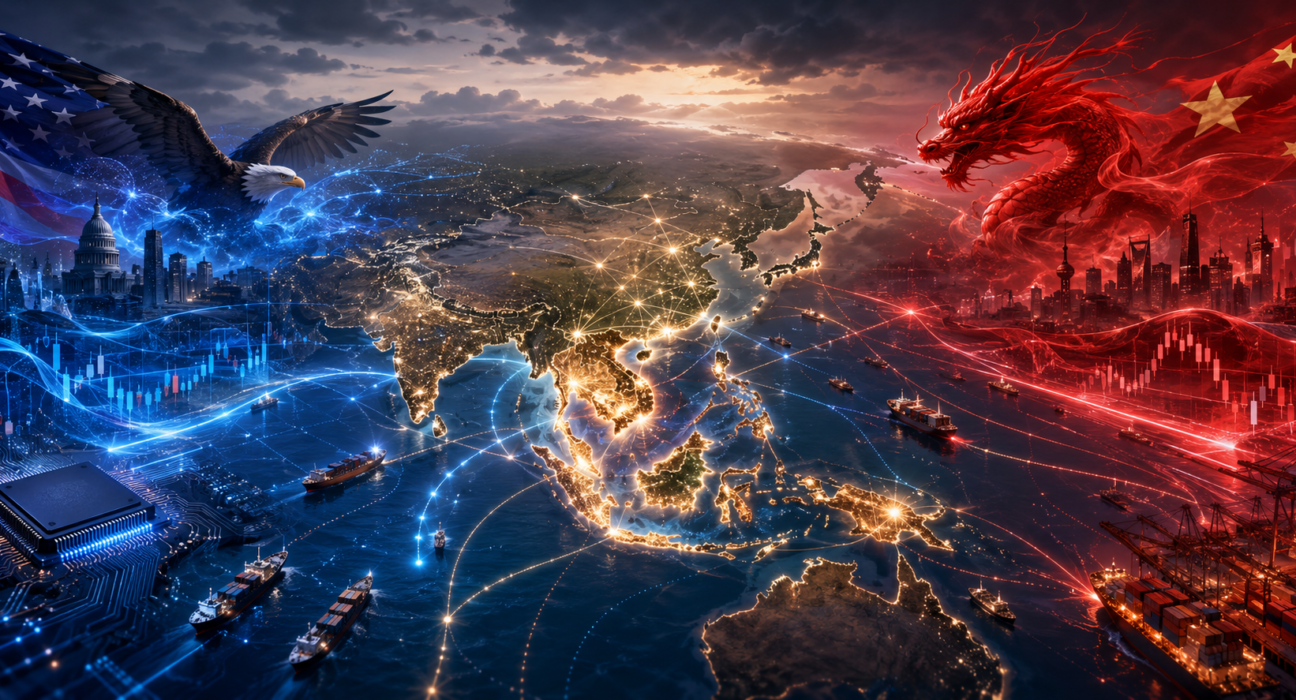
The impact of China-US tensions on Asian markets in 2026 is not only about the stock market. It’s not simply about whether Shanghai, Hong Kong, Tokyo, Seoul, or Taipei go up or down. The real question runs deeper: are Asian markets still economic markets, or are they gradually becoming geopolitical markets?
In my view, this is the heart of the issue. The Sino-American rivalry is no longer only a trade war. It has become a battle over standards, technologies, currencies, supply chains, semiconductors, and strategic-level control. In 2026, investors no longer see Asia as a single growth zone. They segment, sort, and rank it. There is Asia exposed to Chinese risk. There is Asia protected by the American umbrella. There is technological Asia. And there is opportunistic Asia, which benefits from factory relocations and the “China+1” strategy.
It is therefore a mistake to say that China-US tensions simply scare Asian markets. They frighten some markets but boost others. They penalize Hong Kong and sometimes mainland China, but they can benefit Taiwan, South Korea, Japan, or certain Southeast Asian countries. In reality, this rivalry does not destroy Asian markets: it reshapes them.
The first consequence is visible in China. Even when Beijing and Washington show a willingness to stabilize, investors stay cautious. After the Trump-Xi summit in May 2026, the yuan hit a three-year high against the dollar, but Chinese stocks declined, as markets sought concrete details rather than political statements. “Reuters” also noted that the summit yielded little to excite Chinese investors.
This teaches us one key thing: confidence cannot be decreed. Beijing can reassure. Washington can announce détente. Both powers can talk about stability. But markets look at tariffs, sanctions, technology restrictions, export controls, and political risk. China is still a huge market, but it has also become a market under scrutiny. Every US decision on chips, every Chinese measure on rare earths, every tension around Taiwan can change risk perception.
The second consequence concerns semiconductors. This is probably the most important point. In 2026, Taiwan and South Korea are at the center of the game. They are geographically vulnerable but technologically essential. That is the paradox. The more the China-US rivalry intensifies, the more strategic these two countries become. The more exposed they are.
South Korea is the most spectacular example. Its exports soared 53.2% year-on-year in May 2026, driven by semiconductors, whose sales increased by 169.4%, according to Reuters. This boom is directly linked to global demand for artificial intelligence, servers, advanced memory, and large US tech groups.
This means South Korea is no longer simply an efficient industrial country. It is becoming one of the lungs of global technological capitalism. The same goes for Taiwan with TSMC. Investors no longer see just an island threatened by Beijing. They also see a global infrastructure without equal. In other words, Taiwan is both a geopolitical risk and a technological insurance. This twofold nature makes Asian markets so hard to read.
The third consequence is therefore a rotation of capital. In the old age of globalization, the saying was: “investing in Asia is equivalent to investing in China.” The new geopolitical era says something else: “investing in Asia means choosing your camp”, “your risk, and your value chain.” This is a major change. China remains central, but it is no longer the obvious choice. South Korea, Taiwan, Japan, India, Vietnam, or Malaysia become alternatives—not because they fully replace China, but because they offer partial exits.
Vietnam illustrates this evolution. Its trade surplus with the United States has surpassed China’s since the second quarter of 2025, according to Reuters. This does not mean Vietnam is replacing China. But it shows that supply chains are shifting, at least in part. Companies don’t always leave China; they add a second production base. That’s the “China+1” strategy: not to cut ties with China, but to stop depending exclusively on it.
But caution is needed. Decoupling is often discussed as if economies will separate cleanly. This is not true. Decoupling is rarely clean. Chinese components remain prevalent in many Asian supply chains. A factory in Vietnam may depend on Chinese parts. A Korean company may sell to China while working with the United States. A Japanese group may benefit from the US umbrella while remaining tied to the Chinese market. So, we are not seeing a clear-cut separation. We are seeing imperfect fragmentation.
Japan, for its part, occupies a unique position. It benefits from its connection with the United States, proximity to Taiwan, its electronics industry, and its role in the semiconductor chain. But it remains exposed to two risks: China as a major trading partner, and the yen as a variable of tension. An overly weak yen can help exporters but also raises import costs, especially for energy. Japan is gaining strategic importance but cannot detach itself from its Asian environment.
India, meanwhile, is a major potential beneficiary of this reshaping. It wants to attract production chains, develop its tech industry, stay close to the US without becoming a mere ally, and continue engaging with the Global South. But India is starting from further behind. It has the demographics, the domestic market, the strategic ambition. But it does not yet have China’s industrial depth or the tech power of Taiwan or South Korea. For markets, India is thus a promise, but one that still needs to be fulfilled.
The real question now becomes: who benefits from the tension? The answer is nuanced. China loses part of its premium of obviousness. Hong Kong suffers from its political exposure. Taiwan and South Korea gain thanks to semiconductors, but with a higher geopolitical risk premium. Japan is regaining strategic status. Vietnam and some ASEAN countries gain as alternative bases. India is attracting attention, but still needs to turn that attention into real industrial power.
That’s why I would say that China-US tensions have transformed Asian markets into a selection space. We can no longer talk about a single “Asian market.” We have to talk about several Asias: pressured Chinese Asia, booming technological Asia, alternative manufacturing Asia, emerging Indian Asia, and resurgent strategic Japanese Asia.
In conclusion, China-US tensions do not only cause instability. They are creating a new financial map of Asia. Capital does not necessarily flee the continent; it moves within it. It sometimes leaves China for Taiwan, Korea, Japan, India, or ASEAN. Investors are no longer seeking only growth. They are looking for security, technology, political clarity, and access to the US market.
That may be the great lesson of 2026: Asian markets are no longer guided solely by economics. They are now guided by geopolitics.
And in this new Asia, the real question has become: where is the right risk?