
by Gilles Touboul
Can a superpower remain credible on multiple fronts at the same time?
The question is no longer whether the United States is powerful. The answer is obvious: it is. The US still possesses the world’s leading military power, an unrivaled network of alliances, substantial financial capacity, and a diplomatic influence that remains central. But the real question now lies elsewhere: can a superpower remain credible when it must manage several theaters simultaneously?
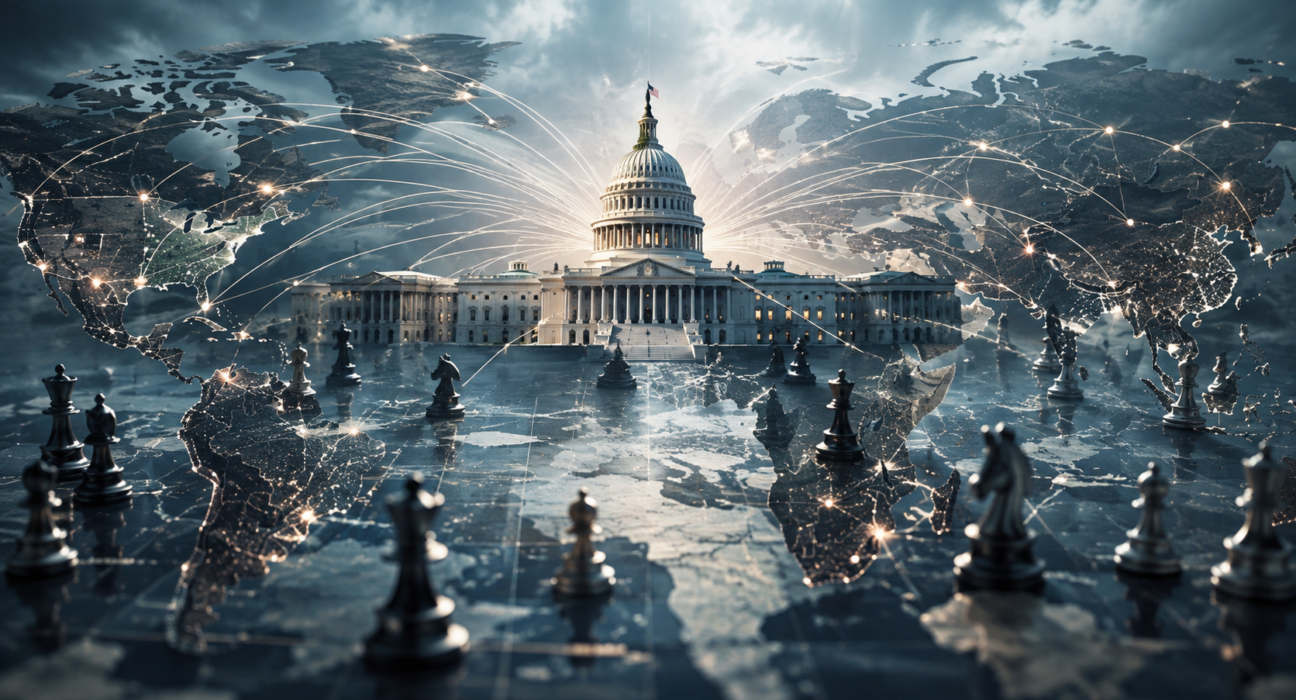
This is where the American risk begins. Not in weakness, but in dispersion. Washington must contain Iran, support Ukraine, reassure Europe, monitor Russia, maintain its presence in the Indo-Pacific, protect Taiwan, respond to China, secure maritime routes, and absorb the constraints of its own domestic politics. None of these issues can be completely abandoned. But none can be addressed without cost.
American power is therefore not disappearing. It is being called upon everywhere. And that is precisely what becomes dangerous. A power can lose not because it is defeated militarily, but because it is forced to respond to too many crises at once. It then becomes reactive. It makes decisions in urgency. It promises much, but must choose where to truly commit its resources.
The problem is also doctrinal. The US defense strategy had already identified China as the primary challenge, Russia as an acute threat, and Iran as an important regional threat. On paper, the hierarchy seems clear. In reality, crises break this hierarchy. The Middle East once again absorbs American attention just as Washington would like to focus on the Indo-Pacific.
But the problem is not just diplomatic. It is also industrial. A war of endurance consumes munitions, interceptors, missiles, stockpiles, budgets, and political time. CSIS estimates that the US still has sufficient means to continue the conflict with Iran, but that the depletion of stocks creates a vulnerability for other scenarios, particularly in the western Pacific. In other words, America can keep striking. But every strike also has a cost for the future.
This is where China observes. Beijing does not just look at the number of American aircraft carriers or the precision of American strikes. Beijing looks at the duration. China seeks to understand if Washington can remain consistent. Can it support Kyiv without weakening Taiwan? Can it contain Iran without diverting attention from the South China Sea? Can it reassure its Asian allies while managing the Gulf and Europe?
For Beijing, the true measure of American power is no longer just strength. It is coherence. Brookings even highlights that the war against Iran gives China a political argument: presenting Washington as a distracted, divided power, less able to fulfill its commitments to Taiwan and its Asian allies.
This point is crucial. The US can win a battle while losing a strategic sequence. It can strike effectively in Iran, but give its Asian allies the impression that its attention is shifting. It can support Ukraine, but let tensions over defense stockpiles appear. It can talk about Indo-Pacific priority while constantly being called back to the Middle East.
This is the American paradox: the power is immense, but the agenda is too broad.
Strategic saturation is not a visible defeat. It does not look like an army retreating. It shows up in delays, in trade-offs, in budget fatigue, in Congressional debates, in the difficulty of delivering certain equipment, in the anxiety of allies, and in the opportunism of adversaries. It shows when each crisis becomes a credibility test for all the others.
That is why American credibility is becoming more fragile than it appears. Washington must not only convince Iran that it can strike. It must convince Ukraine that it can continue. It must convince Taiwan that it will be there. It must convince Japan, Australia, the Philippines, South Korea, Israel, Gulf countries, and Europeans that its commitment is not a variable promise depending on the news of the day.
Moreover, America’s adversaries do not need to defeat the US directly. They can seek to exhaust it. Iran can use time, proxies, and maritime routes. Russia can prolong the war in Ukraine. China can wait, test, observe, advance with small pressures. Each, in its own way, helps to stretch American power.
This does not mean that the United States is doomed. On the contrary, its alliance network remains a major asset. Its economy remains deep. Its technological capacity remains exceptional. But this advantage only produces effects if Washington knows how to prioritize. The real question is not: is America still strong? The real question is: can it remain disciplined?
In my view, strategic saturation becomes America’s main risk because it transforms power into dispersion. It forces Washington to be everywhere, while a strategy always requires making choices. A great power cannot just accumulate commitments. It must define its priorities, accept its limits, and organize its capacity for endurance.
Modern warfare is no longer won by firepower alone. It is determined by the ability to last without becoming disorganized. In this new world, credibility no longer depends only on military power. It depends on consistency, industrial production, political coherence, and the confidence of allies.
The United States is not weak. But it faces a more dangerous question: can it remain strong everywhere and all the time, without ultimately exhausting itself?