
By Amb. Dr. Mohamed Qubaty
The Security Council’s move reflects a broader realization: partial conflict management has failed, and the Red Sea crisis is forcing a recalibration of Yemen strategy.
The Failure of the Freeze
The UN Security Council’s move to terminate the UN Mission to Support the Hodeidah Agreement (UNMHA) is being framed in procedural language: a “technical” two-month rollover, a managed wind-down, and the transfer of residual tasks to the UN Special Envoy’s office. But read closely, the decision is not administrative housekeeping. It is a political message—and a quiet strategic pivot—about how the international system now views Hodeidah, the Stockholm framework, and the limits of “managed escalation” in Yemen’s war.
The UK-drafted resolution extends UNMHA only until March 31, 2026, after which full liquidation and withdrawal begin, with remaining tasks folded into the UN Special Envoy’s track. This sequencing is deliberate: to close one chapter of international conflict management and reopen strategic space—without announcing it as such.
What UNMHA Really Did
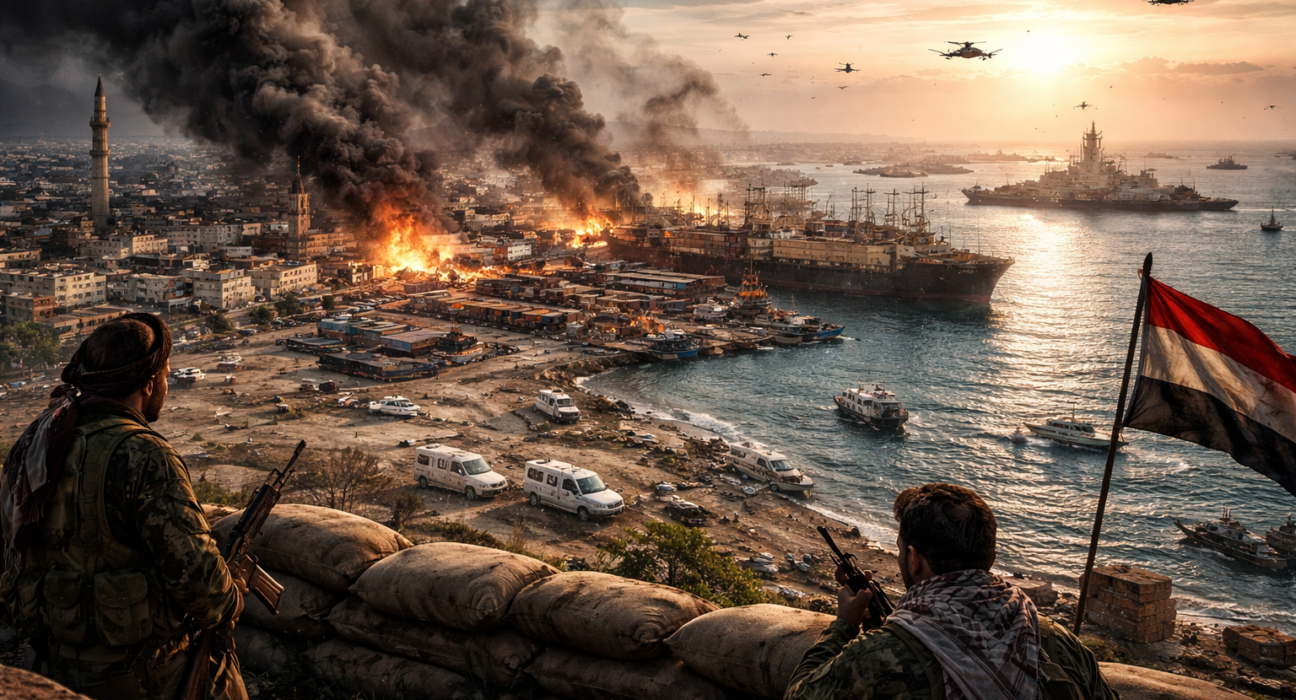
In practice, UNMHA evolved into less of an enforcement mechanism and more of a political buffer zone around Hodeidah. Its presence discouraged any serious attempt to alter the military balance in the port city—even as the Houthis consolidated control, militarized the port environment, and used it as both a strategic and economic hub.
Over time, the mission turned Hodeidah into a protected “exception zone,” where violations could be observed but not corrected—freezing an increasingly asymmetric reality.
What Changes Now
Ending UNMHA removes a key political and legal constraint that had prevented recalibration. While this does not itself authorize military action, it reopens strategic space—allowing Hodeidah to be treated again as part of Yemen’s sovereignty and broader security equation, rather than as a quarantined diplomatic file.
In short, UNMHA’s impact was not in what it changed, but in what it prevented from changing. Its closure signals that the international system is no longer willing to underwrite that freeze.
The Red Sea and Houthi Sabre-Rattling
In late January 2026, the Houthis released a nine-minute video showcasing their attack on the UK-linked MARLIN LUANDA, framing it against a backdrop of escalating regional tensions. Coupled with recent rhetoric, the release appears designed to signal intent should U.S. or allied strikes against Iran intensify.
This calibrated messaging underscores the central argument: partial conflict management has not disincentivized coercive behavior—it has allowed it to mature and adapt.
From Managed Escalation to Strategic Recalibration
Ending UNMHA does not automatically mean “boots on the ground,” but it removes a political and legal barrier that for years discouraged any serious rethinking of the Hodeidah file. The mission’s presence created a de facto veto environment: even when the Houthis violated commitments or militarized the port zone, the existence of an exceptional UN framework made any recalibration appear as a threat to the peace process rather than as a response to non-compliance. With that framework now closing, Hodeidah can no longer be treated as a quarantined diplomatic enclave; it re-enters the strategic equation as a question of sovereignty, deterrence, and regional security.
For much of the past decade, the international response relied on “managed escalation.” Periodic strikes, maritime patrols, and signaling were calibrated to punish without provoking decisive change. This did not dismantle coercive capacity; it taught the Houthis how to operate below critical thresholds and convert disruption into relevance—transforming escalation into a strategic asset rather than a liability.
What changes now is not the inevitability of war, but the opening of strategic choice. The end of UNMHA signals a willingness to move beyond a framework that preserved stalemate. If the international community aligns political and security tracks, empowers legitimate Yemeni actors, and links de-escalation to verifiable constraints, Hodeidah could shift from being a frozen front to a lever for broader stabilization. If not, the vacuum will continue to reward coercion, and escalation will remain the most effective form of political communication.
The Strategic Meaning
UNMHA’s closure is not a budget decision. It is an admission that a framework preserved stalemate rather than balance.
If deterrence is to be rebuilt, it will not be rebuilt at sea alone. It will be rebuilt where strategic depth truly lives: inside Yemen.
The end of UNMHA marks a quiet but consequential shift: the international community is stepping away from a model that froze conflict rather than resolved it. Hodeidah can no longer be treated as a quarantined diplomatic file while it remains central to both Yemen’s sovereignty and Red Sea security.
For deterrence to be credible, it must be anchored inside Yemen—not offshore alone. This requires empowering legitimate Yemeni forces, aligning political and security tracks, and designing humanitarian safeguards from the outset. Without such a recalibration, “managed escalation” will continue to reward coercion rather than contain it.