
by Scott Douglas Jacobsen
How does Harnik Vazgenovich Karanlgtsyan describe the psychological trauma and recovery of Ukrainian veterans?
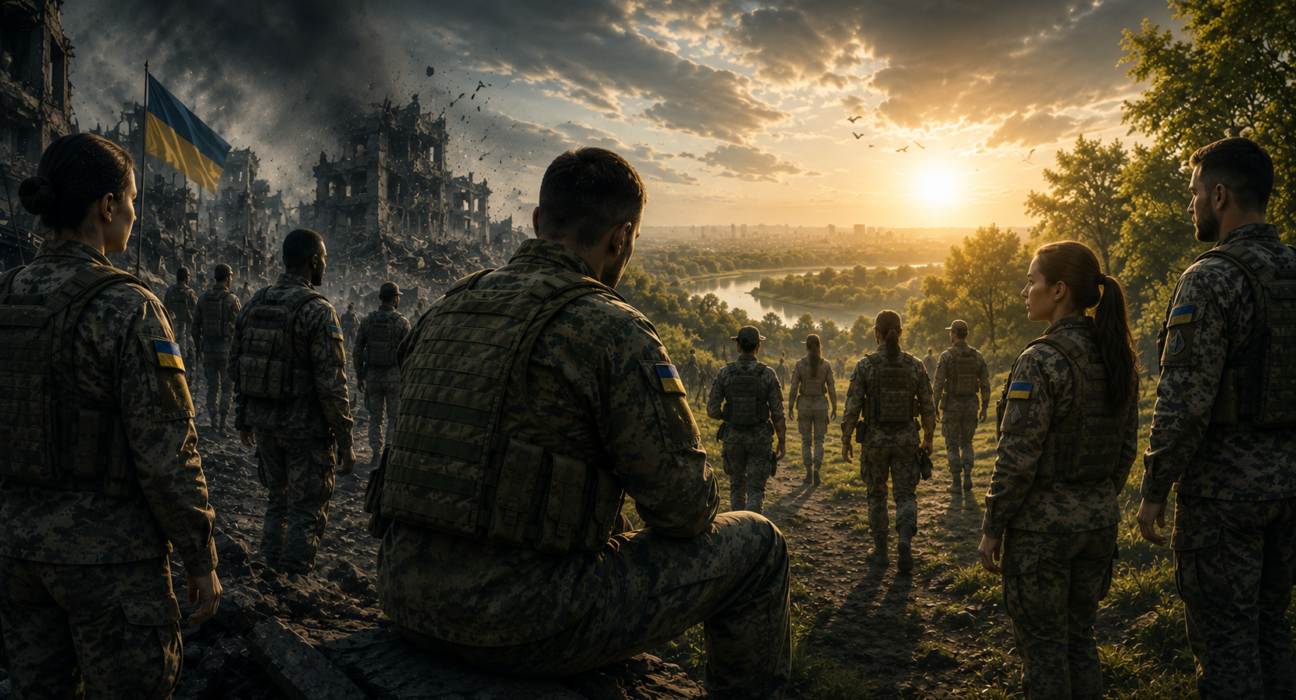
Scott Douglas Jacobsen interviews Harnik Vazgenovich Karanlgtsyan about psychological trauma among Ukrainian veterans and the difficult return to civilian life. Karanlgtsyan describes repeated loss, battlefield horror, stigma around seeking psychological help, and the role of sport, boxing, family, and social gratitude in recovery. He stresses that veterans’ wounds belong not only to individuals but to Ukrainian society, which must reintegrate defenders with empathy, preparedness, and sustained communal responsibility after war and national solidarity over time.
Scott Douglas Jacobsen: What psychological trauma do veterans have? What have they seen that lives in them and cannot be forgotten?
Harnik Vazgenovich Karanlgtsyan: Regarding psychological injuries, we learn from the experience of other countries, including the United States. We try to talk about concussions and psychology. What do the guys experience? They lose their brothers and sisters every day.
You go out on a combat mission with two brothers or sisters. You come back and receive the news that someone has been lost. You do not even have time to remember the people you lost yesterday, because a new day takes another life.
I will give one example. One person held a position alone. Russian troops were attacking. He was alive, but he had four more days before rotation, before he could be relieved. He held the position.
When he shot one Russian soldier, the soldier fell into the trench. This man left him there for four days. He gave him a name and talked to him because he was the only one there. He had no one else to talk to, and he did not want to sleep. He asked him questions: “Vanya, why did you come to me?”
I know this person in Kyiv. I understand that he has psychological problems. Unfortunately, the culture in Ukraine around going to a psychologist is not as developed as it is in some of your countries. Going to a psychologist does not mean you are sick. Unfortunately, many men in Ukraine still think it is a weakness to see a psychologist. I went myself. It is normal.
What soldiers see, the atrocities committed by the Russian army, are impossible to forget. It is impossible. A man goes to the front, or a woman goes to the front — we have many women serving — and they return as different people. What they see changes them.
Maybe it is impossible to cure completely. We will have to live with it. Of course, I am sure many specialists and the state as a whole now have the priority task of helping veterans return to civilian life. The experience of our partners helps, but Ukraine’s challenge is enormous and, in some ways, unique. Others will also learn from how Ukraine deals with this.
Today, many guys cope through sports. Where there is physical strength, a man can release that energy. Guys go to the gym, lift weights, go into the ring, and box. They release their energy that way. We have guys with prostheses who also box. A man may understand that returning to the front will not help his brothers anymore, so he finds another way through physical activity.
I do not think this is ever fully cured. I saw what it is like when you recover bodies. You lift a burned body and see the intestines. How can you forget that? You wrap the body in stretch film so that, at least, it can be returned to the parents who will bury him. They will not forget. We will live with this and always remember who our neighbour is. Unfortunately, we do not choose fate. This fate fell on Ukraine. I do not wish it on anyone.
Jacobsen: We know human beings have limits. If pushed enough, most break. Recovery takes time. Many veterans were broken. What helps them?
Karanlgtsyan: Many veterans return to normal life, but this work belongs to the whole country and to families. When a veteran returns to civilian life, society must not push him away. Sometimes it is enough to say, “Thank you for defending us,” so that the person understands that while he was there, giving his health, strength, and energy, people here appreciated it.
That is why we organize different actions and events. The whole country must be ready to accept our defenders with the problems they will bring back. When they return, the problem is not only theirs. It becomes the problem of society, of the whole Ukrainian population.
There was one case. A man was badly wounded, and people thought he was dead. He was placed in a body bag and loaded onto a KamAZ truck with the deceased. When our doctors checked the bodies, they found a pulse. He was alive.
I know one thing: when the guys come back with problems, those problems become the problems of all Ukrainian society. We have to be ready for that. Then, together, we can somehow overcome it.
Jacobsen: How many veterans want to go back to the front lines but cannot?
Karanlgtsyan: I have not studied this issue statistically. I know many people want to go back.
But there are also veterans who, after demobilization or injury, begin to live again. They want a family, a wife, children. They say they have something else to do in life and want to realize themselves in a different way.
There is also a certain number who return when they are in shape. I know men with prostheses who serve in military units, but in rear positions. What experience they bring and exactly how many there are, I cannot say statistically.
Some want family, children, and wives. Some want to return. Some want to study. Some soldiers become trainers in rehabilitation centres.
Jacobsen: Thank you very much for the opportunity and your time, Harnik.
Scott Douglas Jacobsen is a contributor to The Washington Outsider. He is the Founder and Publisher of In-Sight Publishing (ISBN: 978–1–0692343; 978–1–0673505) and Editor-in-Chief of In-Sight: Interviews (ISSN: 2369–6885). He writes for International Policy Digest (ISSN: 2332–9416), The Humanist (Print: ISSN, 0018–7399; Online: ISSN, 2163–3576), Basic Income Earth Network (UK Registered Charity 1177066), Humanist Perspectives (ISSN: 1719–6337), A Further Inquiry (SubStack), Vocal, Medium, The Good Men Project, The New Enlightenment Project, The Washington Outsider, rabble.ca, and other media. His bibliography index can be found via the Jacobsen Bank at In-Sight Publishing comprised of more than 10,000 articles, interviews, and republications, in more than 200 outlets. He has served in national and international leadership roles within humanist and media organizations, held several academic fellowships, and currently serves on several boards. He is a member in good standing in numerous media organizations, including the Canadian Association of Journalists, PEN Canada (CRA: 88916 2541 RR0001), Reporters Without Borders (SIREN: 343 684 221/SIRET: 343 684 221 00041/EIN: 20–0708028), and others.